OX Radar Checks Which Threats Touch Your Stack
Security teams don't need another feed of scary headlines. They need a fast answer to one question: does this affect us? OX Security is betting that a combined threat monitor and exposure checker can answer it.
The company's new OX Radar and Response Center pairs continuous threat monitoring with automated checks against each customer's own environment. As CEO and co-founder Neatsun Ziv put it, "The question isn't just whether a new threat is dangerous. It's whether it's dangerous to you." He argues that AI-driven development is generating more alerts than teams can realistically investigate, and that's the problem the tools target.
Monitoring, Then Matching
OX Radar watches emerging vulnerabilities, compromised software dependencies, and actively exploited threats. It scans CVE databases, known-exploited vulnerability catalogs, security advisories, and vendor research roughly every 10 minutes. Customer-facing coverage concentrates on the high-priority stuff: malicious or compromised dependencies, exploited vulnerabilities, and critical-severity CVEs.
The Response Center handles the matching. It checks whether vulnerable components are present in a customer's environment and assesses how exploitable they are. Here's the thing: a CVE on a list tells you little until you know whether the vulnerable code is loaded, reachable, and actually used. That's the gap this tool is aimed at.
It draws on the U.S. Cybersecurity and Infrastructure Security Agency (CISA) and the European Union Agency for Cybersecurity (ENISA) Known Exploited Vulnerabilities catalogs, EPSS exploit predictions, and VEX exploitability status. Those inputs get combined with OX Security's AI-generated exploit checks and runtime visibility to determine whether vulnerable libraries are actually affected. Teams can start an investigation from a CVE identifier, a GitHub Security Advisory identifier, or an advisory URL.
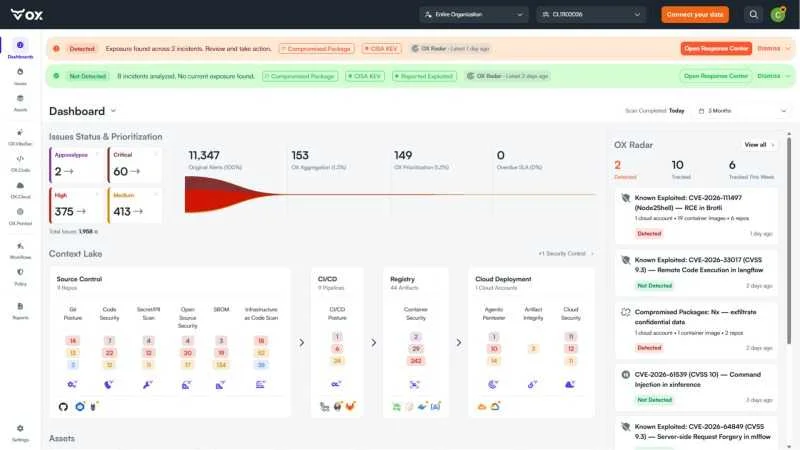
What Teams Can Do With It
The Response Center is built around a five-step workflow:
- Track threats: Follow high-priority incidents as new intelligence and findings emerge.
- Assess exposure: Identify affected assets and examine the supporting evidence.
- Prioritize risk: Weigh severity, exploitation, code usage, and reachability.
- Manage remediation: Access safe versions and guidance, then create or track tickets and fix pull requests.
- Document response: Keep records of findings and remediation activity.
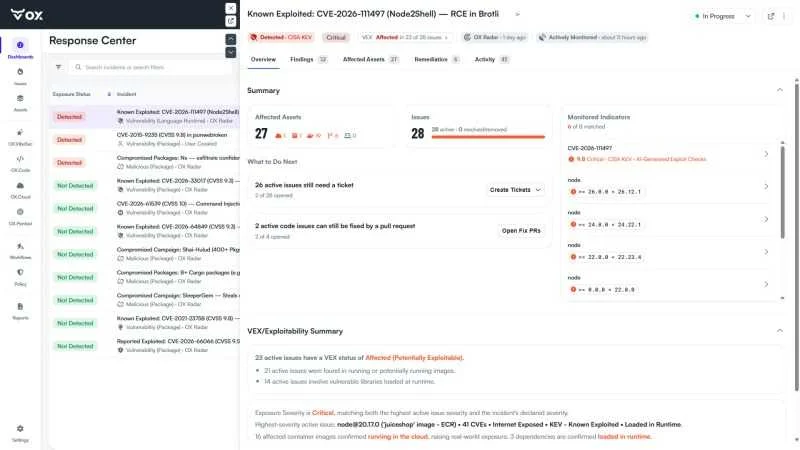
Evidence, Not Just Alerts
For each supported incident, the Response Center shows whether a vulnerability has been detected in the customer's environment and offers evidence of its potential exploitability. It also pulls in available VEX information to indicate whether action is required at all. That last piece matters. A VEX statement can show a component is present but not exploitable in a given context, which keeps teams from chasing findings that don't need a patch this week.
A Public Feed for the Wider Supply Chain
Alongside the customer tools, OX Security is publishing a publicly accessible OX Radar threat feed with a broader catalog of findings. Drawing on the company's own research and scanning, the feed analyzes newly published npm and PyPI packages, AI skills, and Model Context Protocol (MCP) servers.
OX Security says it will keep moving more of this public research into customer-facing checks in the Response Center. That's the part to watch. If findings from the open feed start feeding customer-specific triage, it stops being a news source and becomes a working input for security teams.
Availability
OX Radar and Response Center are available to OX Security customers as part of its AI-Native Application Protection Platform (AINAPP). The broader OX Radar research feed is publicly accessible through the OX Security website.
OX Security describes itself as an AI-native application protection platform built to secure software from prompt to production runtime. Its platform includes VibeSec, OX Code, OX Cloud, and OX Agentic Pentester. The open question is whether the public feed's coverage of npm, PyPI, and MCP servers can keep pace with the components teams are actually shipping.