Anthropic’s $17 Billion Quarter Shows the Cost of Scaling AI Compute
Anthropic’s latest quarter makes the economics of scaling an AI lab harder to ignore: revenue jumped, but securing enough compute absorbed a larger share of every dollar. For companies racing to meet demand, access to infrastructure can shape margins as directly as customer growth does. That tension is central to the filing: sales are expanding quickly, yet the resources needed to serve them are growing more expensive too. Revenue growth tells only part of the story when each additional workload depends on capacity the company may have to buy at a premium.
Revenue rose as compute costs climbed
An update to Anthropic’s S-1 filing, released Monday, extends its financial disclosures through September 30. Revenue reached $17 billion, up from $11.5 billion in the prior quarter. That is a steep sequential increase, but it came alongside a wider operating loss, with rising compute costs a major factor. The combination matters because it shows that demand can outpace the financial benefits of scale when the infrastructure behind a product is costly to secure.
Compute accounted for 58% of revenue in the latest quarter, compared with 48% in the quarter before. The filing’s measure of revenue per dollar spent on compute had climbed since the start of 2025, briefly passing 2x, before falling to 1.72x in the latest period. That ratio offers a rough view of how much revenue the company generates relative to its compute spending; the decline suggests that recent growth has required more infrastructure expense per dollar of revenue. It doesn’t, by itself, explain the causes of the change, but it makes the trade-off visible.
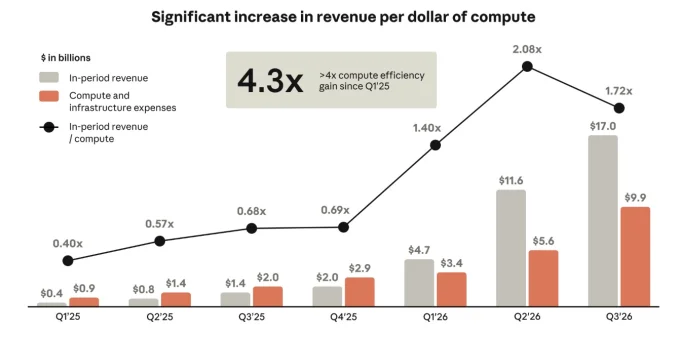
The pressure reflects how quickly Anthropic has had to add capacity. Its compute bill reached $10 billion for the quarter, including $5 billion from short-term commitments. The filing says that capacity currently costs “significantly more than comparable compute procured under our multi-year commitments.” In other words, when demand outruns planned supply, the company pays a premium to keep workloads running. Those expenses aren’t simply an abstract cost of growth: they affect how much of the new revenue remains after the infrastructure bill is paid.
Short-term capacity comes at a premium
Anthropic’s disclosed infrastructure deals include payments to SpaceX of $1.25 billion a month for compute, alongside multibillion-dollar agreements with Nscale, Akamai, and Volta. These providers are often called neoclouds: smaller operators offering more flexible capacity, typically at higher rates than large cloud providers. The mix points to a company assembling supply from multiple sources as it tries to keep up with demand. Flexibility can help address an immediate shortfall, but it carries a direct cost when the available capacity is more expensive than what long-term agreements provide.
The filings don’t suggest Anthropic can quickly outgrow that reliance. The company expects infrastructure and compute expenses to rise in absolute terms and remain its largest operating cost “for the foreseeable future,” as capacity from multi-year cloud agreements comes online and it continues to invest in compute. That expectation puts the current figures in context: the latest quarter’s elevated spending isn’t presented as a temporary anomaly that will vanish as soon as one new supply contract begins. The company is planning for continued high infrastructure needs even as committed capacity expands.
Anthropic is also working to build more of its own capacity through a project called “Anthropic Direct.” That could help control costs over time, but the company’s pace of demand growth means owned capacity is unlikely to replace outside providers soon. For now, flexible short-term supply fills the gap, even as it weighs on margins. This is more significant than it looks: the question isn’t just how much capacity Anthropic can eventually own, but how quickly it can bring that capacity into service while customers are already using the product.
Growth still depends on infrastructure supply
With revenue rising by nearly 50% quarter over quarter, investors may tolerate higher compute spending while demand remains strong. If growth cools, the same cost base could look less comfortable; at the same time, slower expansion in demand might give capacity plans time to catch up. That makes the financial picture sensitive to two moving parts: how quickly revenue grows and how efficiently new infrastructure can support it. Strong sales can soften concern about high costs, but they don’t remove the need to manage those costs.
That leaves Anthropic exposed to the pace and cost of the wider data center buildout. The filing’s numbers show that strong sales alone don’t guarantee improving economics when compute supply is tight. If you’re working in this space, the practical lesson is that infrastructure access has become part of the business model itself: a product can attract demand faster than a company can secure affordable capacity to serve it. The next signal to watch is whether new long-term capacity can bring down the cost of serving each additional dollar of revenue.
What the filing says about the next phase
Anthropic’s disclosures frame the near-term challenge clearly. It has substantial revenue growth, but compute spending is rising alongside it, and short-term commitments carry a higher price than comparable capacity secured through multi-year deals. The company’s plans to expand committed and owned capacity may improve the mix over time, though the filing also anticipates continued increases in infrastructure expense.
And yet, there’s no simple efficiency verdict in these figures. The revenue-per-compute-dollar measure has fallen from its recent peak, while revenue itself has climbed sharply; both facts matter. The filing gives readers a way to track the tension, but the disclosed quarter doesn’t establish whether the latest ratio reflects a lasting shift or a temporary mismatch between demand and available supply. For now, the main test is whether capacity catches up without making each new dollar of sales increasingly expensive to support. A hard balance.