Teghaza 001 Meteorite Reveals Early Mars’ Water and Rock Exchange
A meteorite found in the Sahara is giving researchers a rare chemical record of how water and rock interacted on early Mars. Named Teghaza 001, the roughly two-pound fragment is at least 4.1 billion years old, making it one of the oldest known samples from the planet. Its size is modest; the evidence inside it isn’t. Mineral grains can preserve traces of environments that have long since changed, giving scientists a way to study ancient Mars through material that arrived on Earth.
A record written in mineral chemistry
Studies published in Science and Science Advances found that tiny apatite crystals in the meteorite preserve hydrogen signatures from two sources: Mars’ interior and its ancient hydrosphere. That combination matters because it links processes below the surface with water at the surface. The finding points to crustal material being altered by water, preserving evidence of conditions that most Martian meteorites don’t reveal.
Hydrogen can occur in different forms, and those signatures give researchers clues about where the material came from and what it encountered. In this case, the crystals act as small archives: they hold evidence of more than one source in a single rock. The result doesn’t reconstruct an entire Martian environment, but it offers a more direct record of water-rock interaction than scientists can get from a meteorite whose minerals lack such traces.
“One of the paper’s reviewers called it a Rosetta Stone for Mars,” Yang Liu of NASA’s Jet Propulsion Laboratory said in a press release. The comparison captures the specimen’s appeal, though the metaphor has limits: a chemical record can help decode a planet’s history without answering every question about it. What it does provide is a rare link between the planet’s interior and the water that once altered its crust.
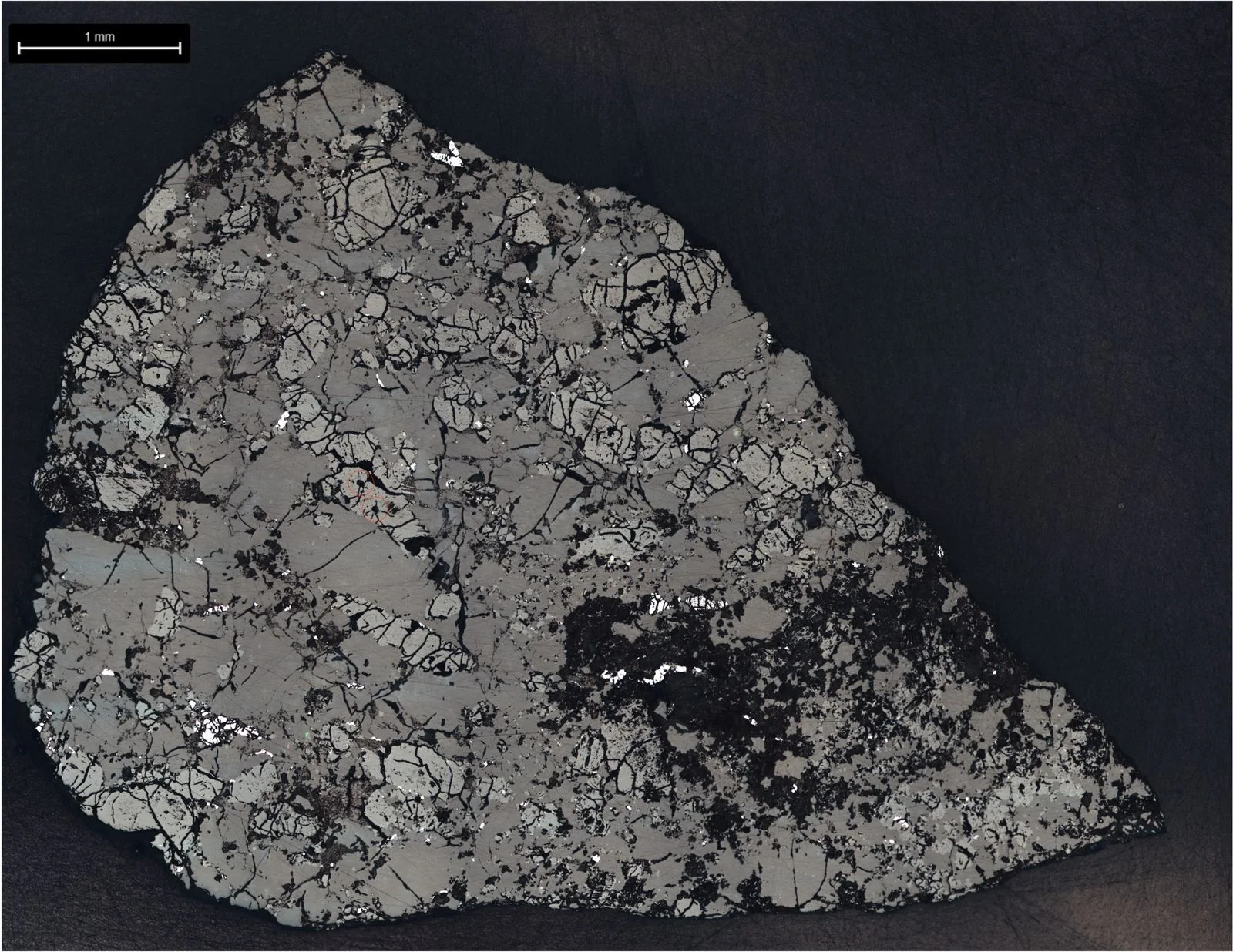
The rock records an exchange between magma below the surface and water above it. That process took place relatively early: Teghaza 001 formed about 500 million years after Mars and the rest of the solar system took shape. Its chemistry could therefore help researchers examine how the young planet’s interior and surface influenced one another, when both were still part of a changing system.
Clues to a changing planet
Mars is now cold and dry, but evidence from space missions points to a past with rivers, lakes and perhaps larger bodies of water. Scientists are still working out how that environment changed, and whether it ever supported conditions suitable for microscopic life. Teghaza 001 adds a direct sample of water-altered crust to that investigation. It doesn’t establish that life existed, or that the planet stayed wet for any particular length of time; it gives researchers material with which to test ideas about the planet’s early history.
“This is really our first piece of Martian crust from a part of Mars we’ve never had a sample of before,” said Lee Saper, a NASA scientist who contributed to the research. “It records interactions of water and rock and maybe even an imprint of the Martian atmosphere as it was losing water.” The possibility of an atmospheric imprint is especially suggestive, but the wording is appropriately cautious: it’s a clue researchers can examine, not a complete account of how Mars lost its water.
The fragment was likely blasted from Mars by an impact before traveling through space and landing on Earth. Its discovery in the Sahara in 2022 adds an unusual specimen to a region where researchers have recovered meteorites and fossils, including a 4.5-billion-year-old fragment that may have come from a vanished protoplanet. Finding a rock on Earth doesn’t make its journey easy to reconstruct, but its Martian origin and preserved chemistry make it a useful piece of evidence once researchers can identify and study it.
What a single meteorite can—and can’t—tell us
Rovers and future sample-return efforts can investigate Mars in place, while meteorites offer another route into its deep past. Each method has limits: a rover studies its surroundings, and a meteorite is a fragment whose original location and history may be difficult to pin down. Teghaza 001’s value lies in the detail preserved inside its crystals: a chemical trace of the planet while liquid water still interacted with its crust.
This is more significant than it looks. A small sample can connect evidence from the planet’s interior, crust and water, helping researchers ask more focused questions about how those parts interacted. If you’re working in this space, the practical point is that mineral chemistry can preserve information that broad descriptions of an ancient wet Mars cannot. The record is still partial. But it’s a record that can be compared with other Martian evidence as scientists refine their picture of the planet’s past.
(And this is the part most people overlook.) A meteorite doesn’t arrive with a map of where it formed or a full account of what happened to it. Researchers have to infer that history from its composition and structure, so each new clue matters most when it can be read alongside other evidence. A useful specimen, then. Not a final answer.
This story originally appeared on WIRED en Español and has been translated from Spanish.