AI Agent Memory Systems: Types, Storage Patterns, and Frameworks
The AI Agent Memory Stack: Building Blocks, Patterns, and Frameworks
By Bala Priya C · November 2, 2026 · Artificial Intelligence
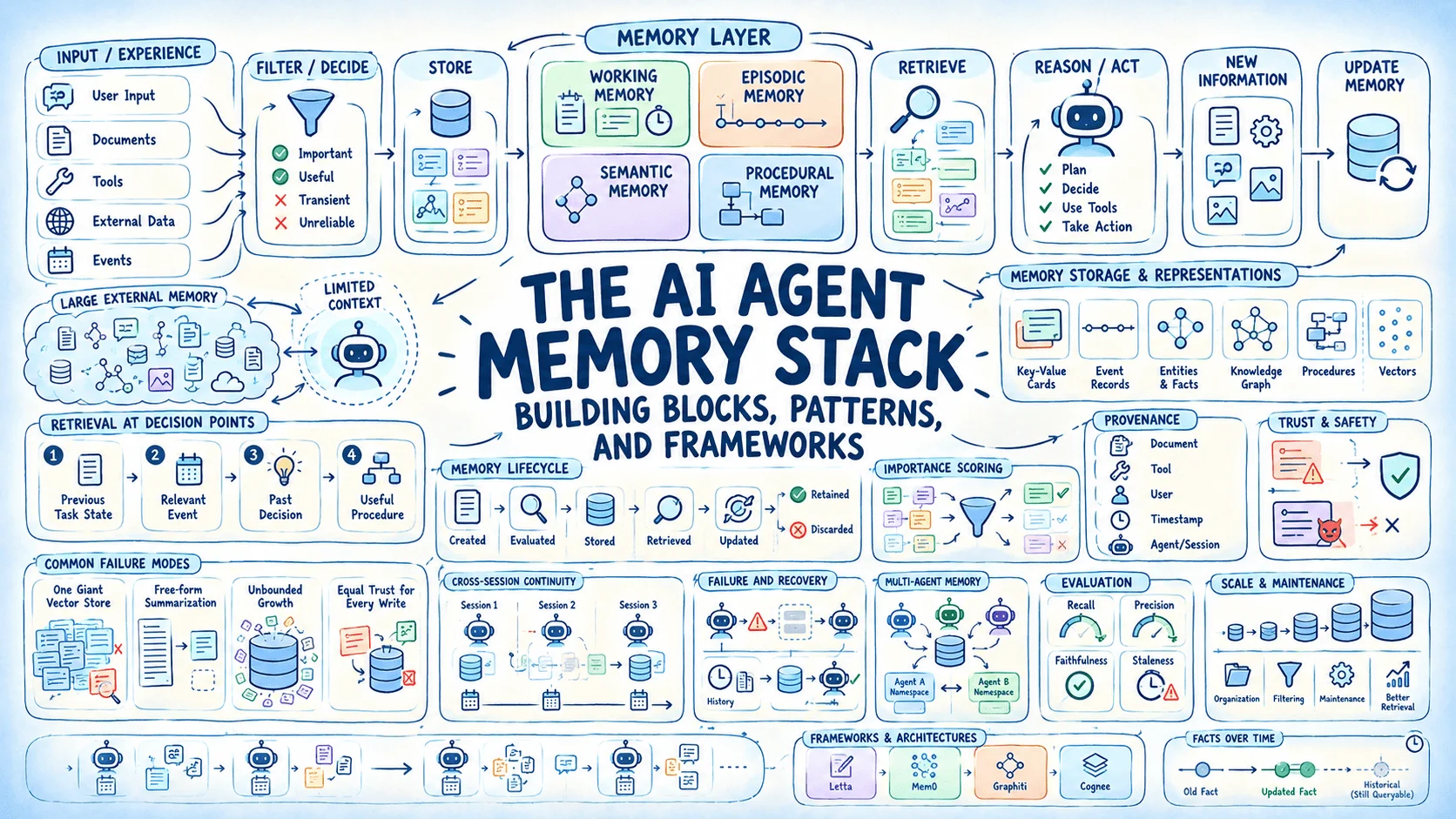
Agent memory is less about giving a model a longer past than about deciding which parts of that past deserve to survive. Get that wrong, and an agent can repeat work, miss useful context, or treat unreliable information as fact. This article looks at the memory types, design choices, and frameworks behind those tradeoffs.
Why agents need memory
A language model doesn’t automatically carry information from one call to the next. It works from the text in its current request. That’s fine for a one-off question, but an AI agent may need to track actions, recall a user’s preferences, or resume a task after several steps.
Memory gives an agent a way to store information outside its context window and retrieve it when needed. The hard part is choosing what to keep and how to find it again. Different memory types serve different purposes, and storage and retrieval choices affect whether the agent can use that information reliably. For a quick primer, see AI agent memory explained in three levels.
Here’s the thing: an agent that forgets everything between calls can’t reliably know what it has already scheduled, learned, or tried. Memory can preserve those details across sessions and tasks, including failed approaches that shouldn’t be repeated.
Four kinds of agent memory
Before comparing frameworks, it helps to separate the jobs memory has to do. Agent memory is commonly grouped into four types, each with a different role and retrieval pattern.
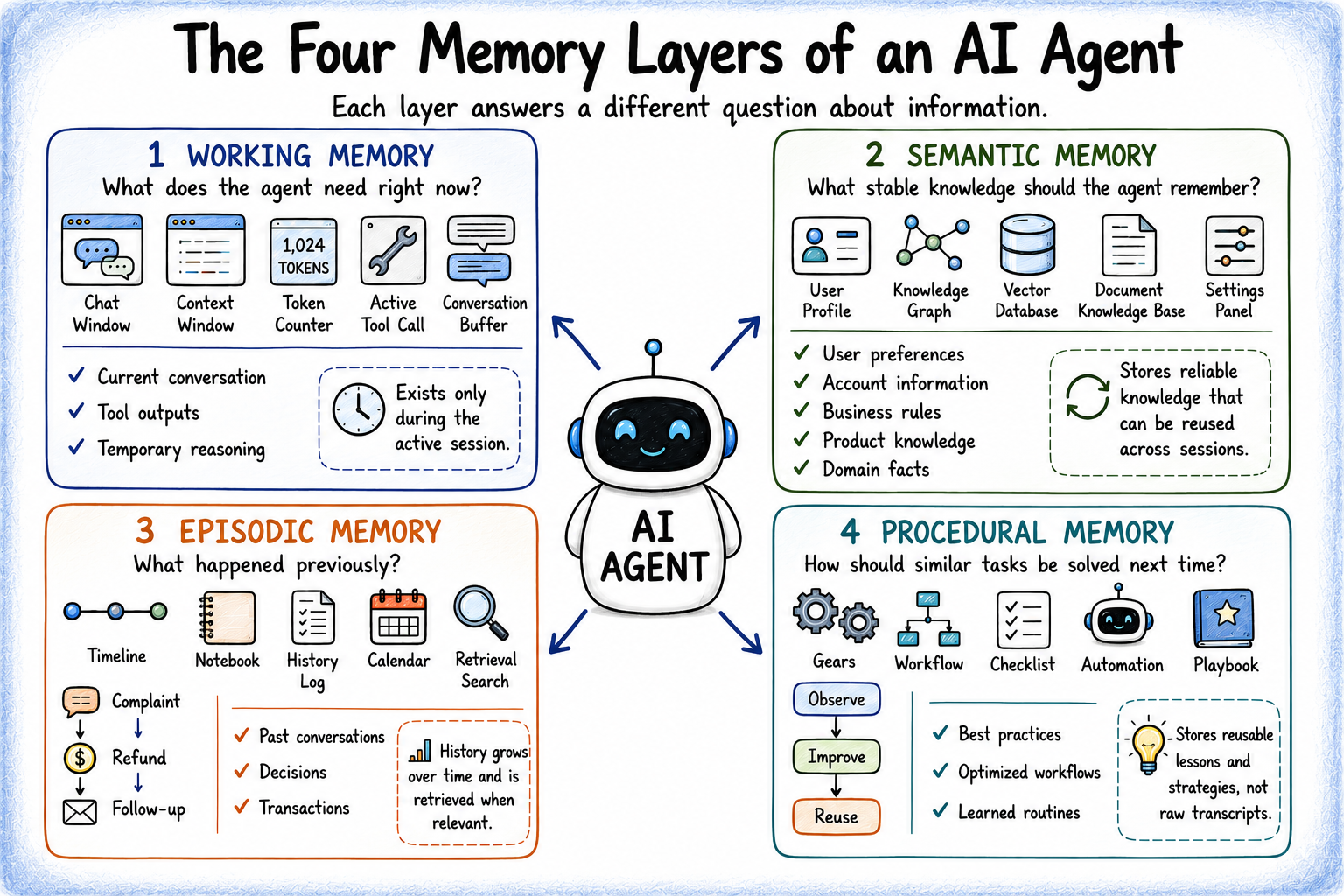
| Memory type | What it holds | Typical storage | How it’s retrieved |
|---|---|---|---|
| Working | Current task state, intermediate results, and scratchpad values | In-memory storage or a short-lived key-value store | Direct lookup by key |
| Episodic | Past events, task runs, interactions, and decisions | A time-ordered log or vector store | Semantic similarity search |
| Semantic | Facts and preferences that may be updated rather than simply appended | A key-value or entity store | Lookup by attribute, sometimes paired with semantic search |
| Procedural | Ways to carry out tasks, including effective action patterns and known failure modes | Prompt templates or fine-tuning | Pattern matching or direct injection |
Working memory is the active information in context. Episodic memory records what happened; semantic memory captures what the system believes to be true about users, entities, or its environment. Procedural memory encodes how to act. Keeping those roles distinct makes it easier to choose what to store and how to retrieve it.
Designing memory for real tasks
Knowing the categories is only the start. A useful memory system needs rules for what gets written, how long it stays, and when it comes back into context. Those choices matter most in workflows that span many steps or days.
A research agent over several days
Imagine an agent collecting sources, extracting claims, and drafting sections over multiple days. After each step, it could save the result in working memory with a short expiry and attach metadata about the tool and session that produced it. If a result proves useful, the agent could promote it to episodic memory with an importance score. Temporary observations can expire; decisions that shape later work can remain.
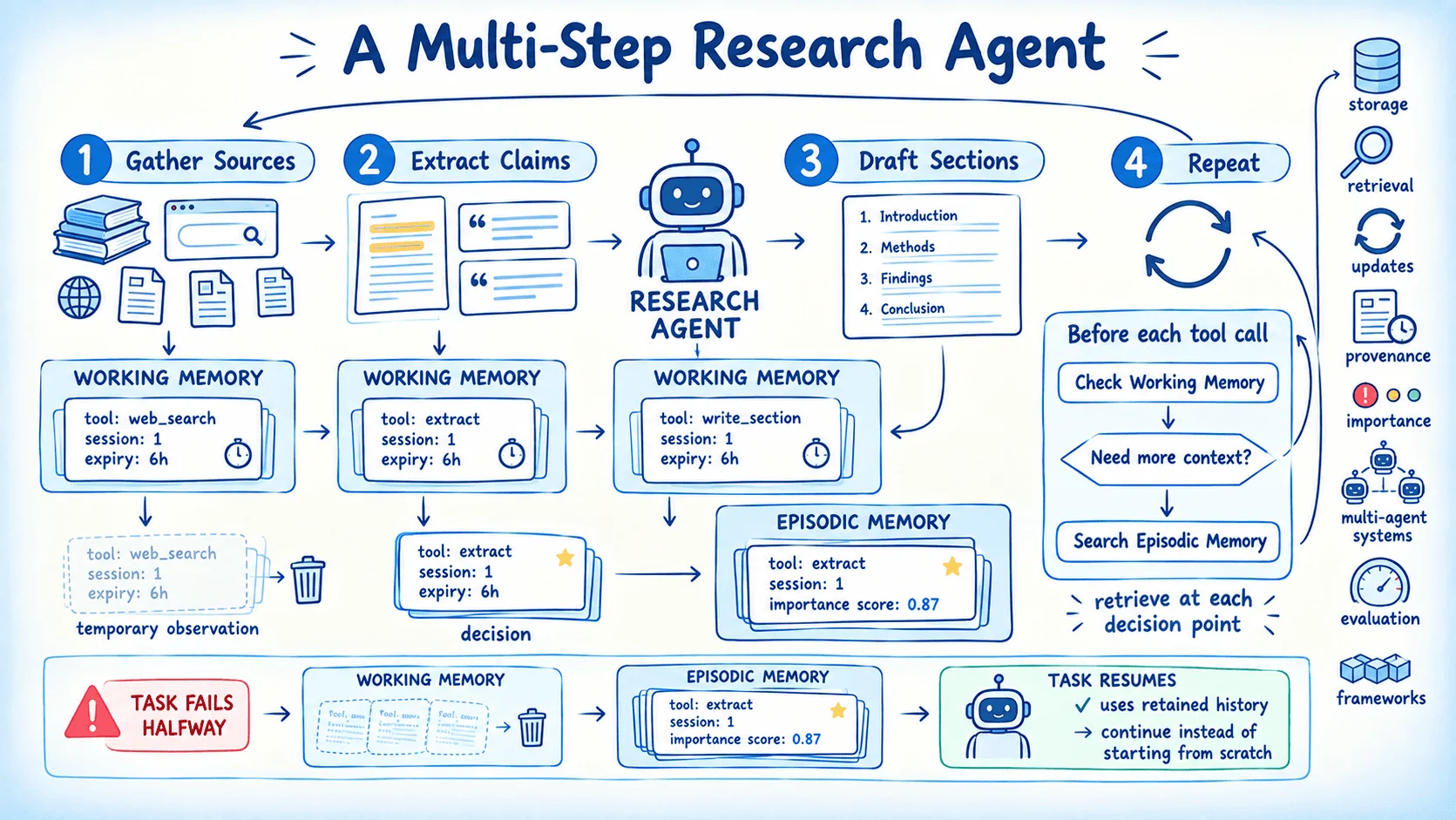
At each decision point, the agent can check working memory for current state and search episodic memory for earlier context. That repeated retrieval is more practical than loading everything once at the beginning: what matters can change as the task unfolds.
If the work stops halfway through, temporary state can be cleared while the record of completed steps remains. When the agent resumes, it has a history to draw on instead of having to start over.
What tends to help
- Assign importance before writing. Filtering out fleeting observations and low-value tool output keeps the store focused on information likely to matter later.
- Limit memory by agent role. In a multi-agent system, role-specific stores can reduce irrelevant or conflicting information.
- Retrieve throughout the workflow. Refreshing context at decision points helps the agent respond to changes as the task progresses.
- Record provenance. Track whether an item came from a user, agent, tool, or timestamp so it can be debugged and audited.
These practices help preserve useful context as tasks lengthen and the store grows. But several shortcuts can make retrieval less dependable.
Where simple approaches break down
| Approach | Problem |
|---|---|
| Putting everything in one vector store | Similarity can surface content that sounds related but doesn’t fit the task, while relationships among facts remain hard to represent. |
| Compressing memory with free-form summaries | Summaries can drop precise details, constraints, or numbers, and may carry an incorrect claim forward as though it were verified. |
| Letting memory grow without maintenance | Irrelevant entries compete with useful ones, which can lower retrieval quality and raise storage and maintenance costs. |
| Treating every write as equally trustworthy | Untrusted or adversarial content may be stored and later treated as reliable, creating a risk of memory poisoning. |
The underlying mistake is treating memory as one undifferentiated pile. Reliable designs separate information by purpose, use suitable retrieval rules, and account for how much each item should be trusted. For more on those tradeoffs, see AI Agent Memory Design: What Works and What Doesn’t.
Frameworks and memory at scale
The design patterns above can be implemented in different ways. Frameworks make their own choices about storage, retrieval, structure, and maintenance, and those choices affect how systems deal with relationships and changing facts. The frameworks below offer a sample of those approaches, not a complete catalog. A broader comparison is available in this round-up of agent memory frameworks.
Different models for changing facts
Some frameworks keep memory close to editable text; others use vectors, graphs, or several data layers. That design shapes how an agent finds connected facts and what happens when stored information changes.
| Framework | Memory model | How it handles changed facts |
|---|---|---|
| Letta | Text blocks that the agent can edit directly | The model detects a contradiction and revises the block |
| Mem0 | Vector memory with entity-aware retrieval | New memories are added and retrieved alongside existing ones |
| Graphiti | A bi-temporal knowledge graph with typed links between entities | Older relationships are invalidated while their history remains queryable |
| Cognee | An extraction pipeline that builds graph, vector, and relational layers from source data | The memory representation is rebuilt, with temporal modes available to track change |
The differences matter when the job gets more demanding. A simpler memory layer may be enough to retrieve relevant facts or recent context. If an agent must follow links between entities, reason across several facts, or retain a record of how information changed, a structured model may be a better fit. For a closer look at the approaches from Letta, Mem0, Graphiti, and Cognee, see Agent Memory Systems and Knowledge Graphs: Letta, Mem0, Graphiti, and Cognee.
Sharing memory and measuring results
More complex memory systems raise two practical questions: how multiple agents share and update information, and how to tell whether memory is helping. Those issues become harder to ignore as systems grow.
Evaluation and shared memory
Memory quality depends on more than whether an agent can store information. Teams need to measure whether retrieval finds relevant memories (recall), avoids flooding the agent with unrelated material (precision), and supports reasoning that uses the retrieved details correctly (faithfulness). Staleness matters too: a system that returns outdated information can undermine otherwise sound decisions.
Shared memory adds a coordination problem. When agents update the same records concurrently, their changes can conflict. A central service with write controls, separate namespaces for each agent, or append-only logs with conflicts resolved during retrieval are common ways to manage that risk. The right choice depends on how agents share information and how updates are handled.
These decisions grow more consequential as memory stores expand, tasks last longer, and more agents rely on the same data. For more on the engineering tradeoffs, see Why Multi-Agent Systems Need Memory Engineering from the MongoDB blog, or take DeepLearning.AI’s Building Memory-Aware Agents course.
Summary
Memory is the layer that lets an agent carry information between calls, tasks, and sessions. Building it well means making deliberate choices about where information lives, how the agent retrieves and updates it, and when it should be maintained or retired.
The design patterns and frameworks covered in this article come with tradeoffs, and longer-running or multi-agent systems add demands around evaluation, consistency, and upkeep. There’s no single setup that fits every workload. If you’re choosing an approach for a particular use case, Choosing the Right AI Agent Memory Strategy: A Decision-Tree Approach offers a way to narrow the options.