LLMJacking Attacks Exploit Stolen Cloud Access to Generate Six-Figure AI Bills
|
5 min read
LLMJacking turns stolen cloud access into six-figure bills
Mandiant investigated multiple LLMJacking incidents in 2026, involving threat actors who hijacked enterprise access to large language models. The cases crossed cloud and LLM providers and affected organizations in North America, South America, and Asia Pacific, across financial services, retail, technology, and transportation. The financial impact can arrive far faster than with cryptojacking. In individual incidents, fraudulent resource use exceeded $100,000 in a day; some organizations accumulated charges of up to $1 million before access was revoked. That speed is the point: a compromised model account can turn into a major bill within hours.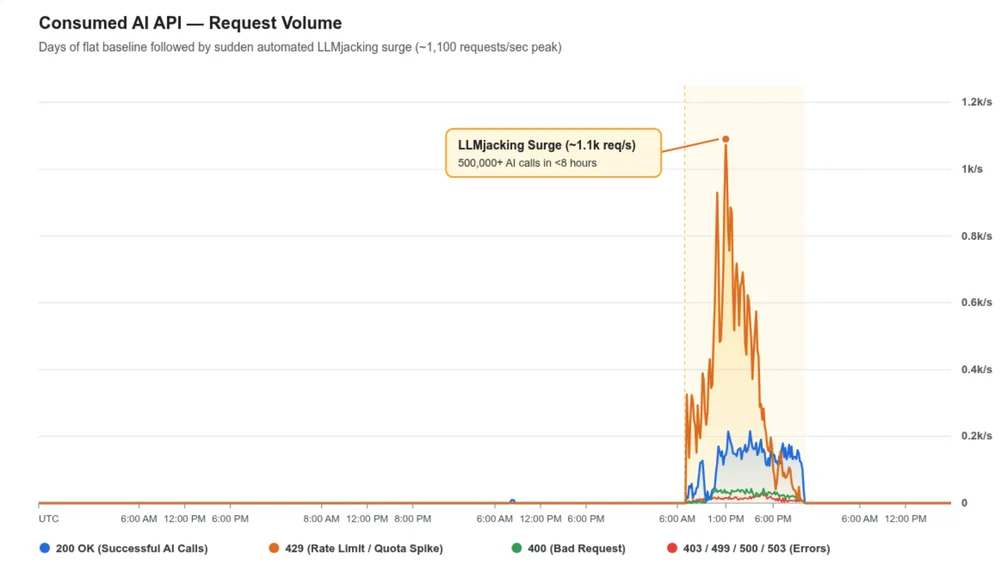 *Figure 1: Usage chart showing LLMJacking generating a spike in API requests*
The mechanics behind those bills are becoming more organized. Building on its [earlier reporting on the underground market for LLM credentials](https://cloud.google.com/blog/topics/threat-intelligence/from-prompting-to-autonomy-the-evolution-of-adversarial-ai), Google Threat Intelligence Group (GTIG) identified financially motivated clusters operating across multiple regions. The division of labor is telling: some actors break into enterprise environments, while others run “LLM Mixers”—illicit gateways that pool, route, and resell stolen model access. In one investigation, two distinct clusters coordinated to compromise and monetize enterprise LLM infrastructure.
This article traces the attack lifecycle seen in those investigations and offers guidance for detection, hardening, and recovery.
Initial access: exposed endpoints and stolen identities
Some resource theft has involved manipulating [customer support chatbots](https://www.cio.com/article/4155404/ai-token-freeloaders-are-coming-for-your-customer-support-chatbot.html) to perform unauthorized tasks such as code generation. LLMJacking goes deeper. Attackers target backend model resources directly, either by finding publicly exposed endpoints or by obtaining valid API keys. Figure 1 shows an automated script checking whether an exposed service accepts requests at the `/api/create` endpoint, allowing the actor to run their own models on infrastructure left accessible by its owners. An unprotected endpoint creates two problems at once: an entry point and an open-ended hosting bill.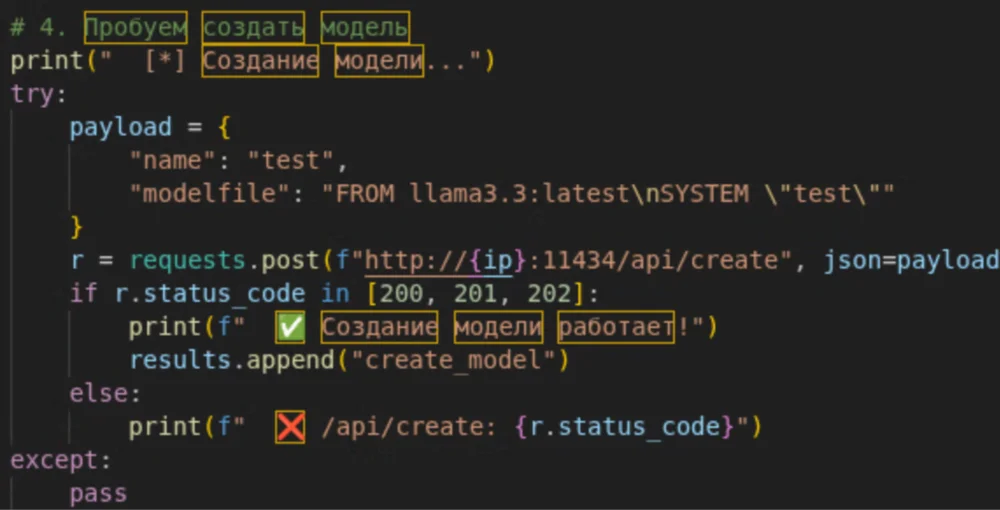 *Figure 2: Threat Actor tests publicly exposed Ollama endpoints and attempts to register their own models*
Across the cases, though, the more common route in was compromised cloud identity material: IAM credentials, Service Account keys, GitHub Personal Access Tokens (PATs), and active session tokens.
In mid-2026, UNC6993 used a misconfigured Service Account key to access a cloud instance, then expanded that access to an LLM API. The same cluster hosted a session-hijacking page disguised as an application portal. It sent users to the legitimate LLM service and asked them to paste a raw JSON payload containing an active access token. The token was then submitted to the actor’s backend, bypassing password and multifactor authentication (MFA) controls.
Other intrusions combined stolen credentials with software weaknesses. One actor used a stolen PAT to enter private code repositories and exploited a suspected vulnerability in a web application package running in a containerized cloud environment. Another used compromised corporate IAM credentials and cloud federation tokens to generate fresh access keys, sidestepping MFA. In a separate case, the first observed access came through a Service Account key with broad project permissions.
Attackers also searched public GitHub repositories for corporate LLM API keys. One group validated stolen keys with automated, minimal requests using `max_tokens=1`. That kept request volume low enough to evade endpoint detection and response (EDR) and security information and event management (SIEM) volume alerts.
Expanding access and staying inside
After entry, attackers looked for credentials, services, and permissions that could widen their reach. They mapped cloud services and identity policies across regions, searched code repositories for hardcoded secrets and developer credentials, and reviewed access logs for credentials to other cloud environments. One actor also queried cloud data warehouse metadata for database credentials, administrator passwords, and sensitive columns, while performing cloud object storage operations associated with targeted data theft. Cloud permissions and virtual machine settings provided ways to escalate privileges and persist. One actor used token-creation permissions tied to compromised workloads to mint temporary credentials for high-privilege service accounts, then extracted infrastructure credentials, database passwords, and third-party API keys from cloud secret managers. Other actors created unauthorized IAM and service accounts, attached administrative policies to service roles, and added SSH keys to compute instances. One established interactive management sessions with running virtual machines before writing unauthorized SSH public keys into host configuration files. Another created deceptive backdoor service accounts that looked like billing-optimization tools and injected SSH keys across compute instance metadata. The targets also included LLM routing software. In one case, a follow-on cluster received pre-validated Virtual Keys from the group that had gained initial access, then exploited a user ID rebind flaw in LiteLLM’s `/key/regenerate` endpoint, CVE-2026-40217. The flaw let the actor turn standard Virtual Keys into `PROXY_ADMIN` master credentials, giving them deep and persistent control.Turning stolen model access into a business
The objective is to monetize model access and computing resources through token proxying, automated model streaming, and GPU provisioning. Attackers enabled managed generative AI services and created extra API keys to increase capacity. UNC6993 attempted to create additional keys and enable services in victim cloud projects; billing charges quickly passed $100,000. Another actor signed victim accounts up for Pay-As-You-Go agreements, selected premium models, and launched high-volume inference streams. To get around rate limits, the actor repeatedly created and deleted short-lived service accounts, while watching the provider’s billing interface. Some groups also built their own infrastructure on compromised accounts. One enabled agents, deployed public reverse proxies, and used custom Node.js bundles to expose endpoints for multiple leading models under the name `D1337-KAIROS`. It installed a containerized backdoor using the [Manus](https://manus.im) agent framework; the backdoor queried an upstream model to reason through instructions and run commands locally. [SearXNG](https://github.com/searxng/searxng) provided metasearch, while [agent-infra/sandbox](https://github.com/agent-infra/sandbox) supplied execution environments. The actor also sought more compute. It provisioned GPU instances, tried to obtain high-end hardware in multiple regions, and requested quota increases through the cloud provider’s API. It hosted [LiteLLM](https://github.com/BerriAI/litellm) gateways on external servers to manage and route API traffic. The resale market makes the economics more striking. GTIG found actors selling access to compromised API quotas through LLM Mixers. Open-source gateways and custom relays pooled stolen credentials, tracked usage, and obscured where requests originated. UNC6993 used [new-api](https://github.com/QuantumNous/new-api), a centralized model hub and gateway, and [gcli2api](https://github.com/su-kaka/gcli2api), which converts command-line tools into standard model endpoints. GTIG believes the actor sells access through underground storefronts. One service, `jet-night.com`, made more than 500,000 LLM API calls in under eight hours using stolen third-party API keys. It passed nearly $1 million in token costs to the victim organization. Jet Night advertised unlimited access to leading models for about $60 a month, despite a typical consumer price of $100 to $250 for comparable access. GTIG believes stolen keys make those prices possible. The service also announced multiple outages on its public Telegram channel, likely because victims had discovered the compromises and revoked the keys.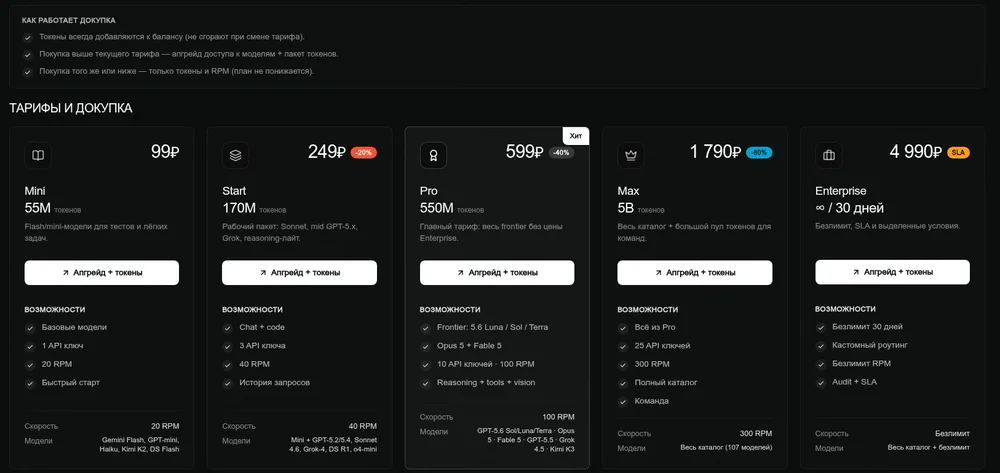 *Figure 3: Screenshot of Jet Night Plans and Pricing Structure*
In another case, an actor used custom `ai-relay` proxy infrastructure on deceptive lookalike domains. One domain was registered to resemble the victim’s legitimate internal host. The relays siphoned commercial LLM access into the `newapi[.]pro` resale ecosystem, drawing directly on the victim’s account quotas to serve underground customers.
What defenders should watch
GTIG expects LLMJacking to attract more criminal attention than traditional resource theft such as cryptojacking. LLM Mixers offer a path to fast, high-margin resale, and wider use of premium models and agentic workflows gives attackers more valuable quotas to target. GTIG expects them to improve automated searches for exposed API tokens and to target flaws in model-routing middleware. The likely result is a larger resale market that can drain enterprise quotas before defenders spot the compromise. The window to catch the activity may be short. Mandiant found cases where LLM services were disabled before compromise; stolen access keys let attackers enable services such as Bedrock or the Gemini API, then generate substantial charges in minutes or hours. Defenders should treat unauthorized changes to LLM accounts and service enablement as critical events. Google Security Operations customers can find related rules in the Cloud Threats, Mandiant Frontline Threats, and Mandiant Hunting Rules packs. One listed rule is **AWS Account Key Creation**.Reduce the routes into cloud-hosted models
Cloud LLM abuse often begins with familiar weaknesses: exposed credentials, excessive permissions, or vulnerable software in the path to a model. The defense has to cover all three. Centralize secrets management and rotate keys automatically so a leak has a shorter useful life. Give users and service accounts only the permissions their jobs require, including explicit control over access to cloud LLM services. Scan repositories such as GitHub and GitLab for committed secrets, and audit cloud configurations regularly for exposed endpoints and unintended access paths. The operational controls matter too. Rate-limit requests with a web application firewall such as Google Cloud Armor, and restrict outbound traffic through VPC firewall rules to known addresses where practical. Set per-model API quotas and spending limits; a compromised key can otherwise turn model access into an unplanned bill. Enforce phishing-resistant MFA across cloud identity providers, management consoles, and developer platforms. Several less obvious controls address how teams use models. Security posture management tools can find unauthorized or unmonitored models and infrastructure. Scope API keys by model endpoint, environment, and usage limit so a token for a basic utility model can’t invoke a costly frontier model. Watch gateway and API logs for tiny validation requests, including `max_tokens=1` or zero-temperature pings: attackers may use these low-volume checks to test credentials before scaling up. The software supply chain deserves the same attention as cloud IAM. Automate SAST, DAST, and SCA scanning across application code, containers, and ML dependencies such as PyTorch and Hugging Face libraries. Patch model proxy and routing gateways such as LiteLLM quickly, including against privilege escalation and authentication bypass flaws such as CVE-2026-40217. If an application runs generated code or database queries, isolate that work in virtualized, process-isolated serverless sandboxes. Restrict model downloads and pipeline dependencies to trusted internal registries or approved enterprise catalogs, and use graph-based risk analysis to trace attack paths across cloud assets, code, and data flows. Automated offensive agents can then test external exposure and simulate credential validation sweeps.Audit logs can show the attack taking shape
Prevention won’t catch every compromised key. Cloud audit logs can reveal the sequence that follows: probing for available models, invoking them, and then trying to hide the activity. That visibility depends on configuration, though. In particular, Google Cloud’s Gemini Enterprise Agent Platform inference events sit in Data Access logs, which are disabled by default because of their volume and ingestion cost. Teams must enable the relevant IAM audit policies themselves. For AWS, track CloudTrail events from `bedrock.amazonaws.com`. Watch for model execution through `Converse`, `InvokeModel`, and `InvokeModelWithResponseStream`. Spikes in `ThrottlingException`, `ValidationException`, or `ResourceNotFoundException` may signal automated attempts to spray requests across cloud infrastructure. Reconnaissance can show up in `ListFoundationModels`, `ListInferenceProfiles`, and `GetFoundationModelAvailability`; attempts to unlock models may use `PutUseCaseForModelAccess` or `CreateFoundationModelAgreement`. Logging changes deserve close scrutiny. Review calls to `GetModelInvocationLoggingConfiguration`, `PutModelInvocationLoggingConfiguration`, and `DeleteModelInvocationLoggingConfiguration. A non-IaC principal disabling invocation logging should be treated as a high-severity event. User-Agent strings can also help identify automation and SDKs communicating directly with infrastructure, including `claude-cli`, `aws-sdk-rust`, and `aws-sdk-go-v2`. Azure requires a split view. Activity Logs cover the control plane, while Diagnostic Logs capture the data plane; model invocations happen on the data plane, so Diagnostic Logs must be enabled to see them. Look for high volumes of POST requests to Completions or Chat Completions endpoints, and for unauthorized deployment creation through `Microsoft.CognitiveServices/accounts/deployments/write`. Reconnaissance may appear as reads of `Microsoft.CognitiveServices/accounts/read` or `Microsoft.CognitiveServices/accounts/deployments/read`. Also monitor reads, writes, and deletions of diagnostic settings through `Microsoft.Insights/diagnosticSettings/read`, `Microsoft.Insights/diagnosticSettings/write`, and `Microsoft.Insights/diagnosticSettings/delete`. For GCP, monitor Cloud Audit Logging for Gemini Enterprise Agent Platform calls at `aiplatform.googleapis.com`. Service activation can be tracked through `google.api.serviceusage.v1.ServiceUsage.EnableService`; alert when it enables the platform. Once Data Access logging is configured, look for inference operations `google.cloud.aiplatform.v1.PredictionService.Predict`, `google.cloud.aiplatform.v1.PredictionService.GenerateContent`, and `google.cloud.aiplatform.v1.PredictionService.StreamGenerateContent`. Model and endpoint discovery may appear in `google.cloud.aiplatform.v1.ModelService.ListModels`, `google.cloud.aiplatform.v1.EndpointService.ListEndpoints`, and `google.cloud.aiplatform.v1.PublisherModelService.ListPublisherModels`. - [Cloud Audit Logging documentation](https://cloud.google.com/logging/docs/audit) - [Google Cloud service usage audit logging](https://docs.cloud.google.com/service-usage/docs/audit-logging)Watch for attempts to inspect the logs
Someone trying to hide activity may first check what the project records and where those records go. Monitor calls togoogle.iam.v1.IAMPolicy.GetIamPolicy, which can reveal whether Data Access logs are enabled, and to google.logging.v2.ConfigServiceV2.ListSinks or google.logging.v2.ConfigServiceV2.GetSink, which expose log export configuration.
The fragment also points defenders to a GTI Collection of IOCs, available to registered users. The listed network indicators are:
| Indicator | Description |
|---|---|
| jet-night.com | LLM Mixer |
| newapi.pro | LLM Mixer |
These indicators give security teams concrete leads to check against network activity. They’re useful starting points, though the fragment doesn’t say how recently they were verified or whether the list is exhaustive.