Google’s PLE Benchmark Tests AI Agents on Real Engineering Work
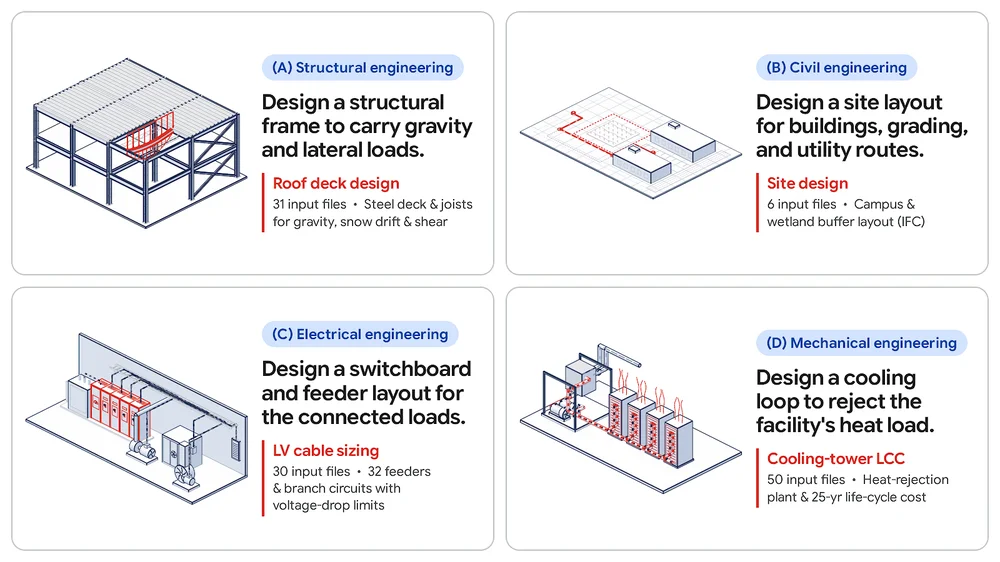
AI agents can solve isolated engineering problems, but producing work that clears safety and feasibility checks across a real project remains a tougher test. Google’s Physical-Engineering’s Last Exam (PLE), developed with Mercor, measures that gap across mechanical, electrical, civil and structural engineering.
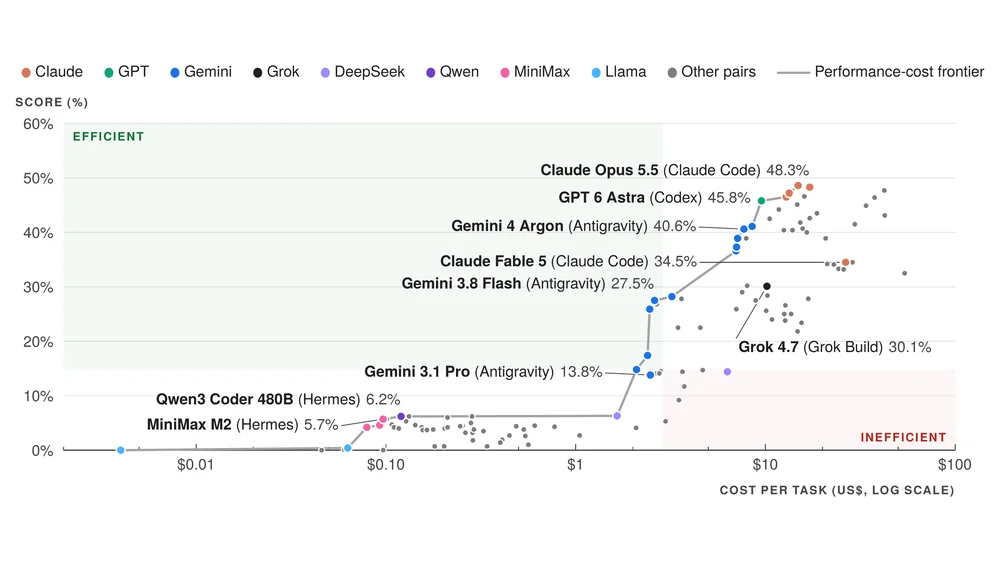
The benchmark’s early results are sobering: all 14 tested frontier models scored below 50% on the private test set. PLE’s value lies in how it evaluates work. An agent must navigate a project’s files, apply relevant codes and physical constraints, perform calculations, and deliver materials suitable for review by a licensed engineer.
Evaluating the work engineers actually do
Many established AI benchmarks center on textbook questions, single tool calls or small design exercises. Those scores say little about whether an agent can handle the connected decisions in an engineering project, where a design must satisfy safety requirements and control costs at the same time.
PLE comprises 85 long-horizon tasks: 30 mechanical, 27 electrical, 18 civil and 10 structural. Each runs in a containerized project folder built on Mercor’s Archipelago environment. A task contains an average of 61 files, with 5,170 files across the benchmark. Materials include PDFs, spreadsheets, emails, 2D CAD drawings, 3D BIM models and document revisions.
That format forces agents to reconcile information spread across a project rather than respond to one prompt. They must identify governing codes and physical limits, then produce deliverables that a licensed reviewer can assess.
Safety checks define the score
PLE makes safety and feasibility threshold conditions: a design earns points only after it passes every hard safety check. This produces a sharper picture of reliability than a score based on how many individual requirements an agent gets right.
The strongest tested configuration met 91% of individual constraints on co-authored tasks, yet only 41.3% of its deliverables cleared every required safety and feasibility check. On the private test set, the top model on its native harness averaged 48.3%.
The comparison also suggests that model choice matters more than the agent harness. Scores varied by as much as 50 points across models, while the median difference across harnesses for the same model was 3 points. Harness selection still had a substantial effect on run cost.
Google tested 14 frontier models with seven publicly available agent harnesses: Antigravity, Claude Code, Codex, Hermes, OpenCode, OpenHands and Pi. The results point to a practical evaluation challenge: strong performance on separate constraints doesn’t guarantee that a complete engineering deliverable will meet every hard requirement.
Tasks draw on practicing engineers
PLE’s 85 tasks were created through two approaches. Practicing engineers authored 44 tasks, including their project folders, prompts and grading rubrics. For the other 41, engineers designed the initial task while an agent pipeline assembled the environment and grader from licensable engineering standards. Engineers then checked and raised the difficulty of each assembled task.
The benchmark is intended to give researchers a shared way to test agents on realistic project inputs and strict evaluation criteria. Google is releasing 29 public tasks, grading scripts and an evaluation container, with a competition leaderboard hosted at ple-bench.com.
Public tasks and competition access
Researchers can read the PLE paper on arXiv and download the public tasks and evaluation tools from the Google Research GitHub repository. Teams can submit their own agent setup for evaluation on the private test set through ple-bench.com. The competition includes 13 Google-sponsored models that run free on Google’s servers; prize details are still to come.
For agent developers, PLE sets a more demanding target than passing isolated engineering checks: deliver a complete, reviewable project that satisfies all hard constraints. Its results suggest there’s still substantial work between capable models and dependable support for physical engineering.