Nammu21 and Google Cloud Put Syndicated Loan Workflows on a Programmable Ledger
Syndicated loans still depend on people and systems to interpret the same agreement, reconcile records and coordinate each step of a transaction. Nammu21’s proof of concept with Google Cloud takes aim at that operational bottleneck: it converts the terms of a credit agreement into a structured digital instrument, then uses those terms to govern loan workflows on Google Cloud Universal Ledger (GCUL).
The project’s significance lies in treating a loan’s rules as executable data that can travel with the facility through its lifecycle. That could help reduce the delays and reconciliation work that burden secondary loan trading. The scale of the challenge is visible in Loan Market Association figures: in the fourth quarter of 2024, settlement for par and near-par secondary market loans averaged 42 days, with a median of 27 days.
From legal terms to digital credit instruments
Loan agreements are often bespoke. They may define distinct tranches, covenants, eligibility requirements, consent rights and operational steps. Agents, borrowers and lenders must coordinate around these provisions, while fragmented records and manual interpretation can leave participants working from different understandings of what a facility permits.
Nammu21’s platform turns the agreement into a Digital Credit Instrument, or DCI. The DCI represents the facility’s governing terms, including conditions, consents, eligibility criteria and operating mechanics, and maps each item to the relevant provision in the source document. Those terms then inform executable behaviours tied to the loan’s current state.
That connection to the original agreement is central to the design. The platform is intended to derive the structured terms programmatically, rather than requiring a person to read and re-enter each provision before a digital workflow can use it. Nammu21 then uses the DCI to generate contracts in gculpy, GCUL’s programming language, defining the obligation’s structure and the actions the loan contract permits, requires or blocks.
GCUL provides the ledger environment for those contracts. It is a permissioned distributed ledger designed for institutional workflows, with controlled participation, transaction finality and predictable costs. The proof of concept uses that environment to create an on-ledger representation of a specific loan facility.
A shared record for a $1.945 billion facility
The demonstration modeled a $1.945 billion Term Loan B, a single segment of a larger transaction involving multiple facilities. The agent bank, borrower, transferor and transferee each worked from a permissioned view of the same on-ledger rendering. The agent bank began by selecting a credit agreement that Nammu21 had transformed into structured terms. Those terms were then used to instantiate a distinct gculpy contract on GCUL, creating a digital twin of the facility.
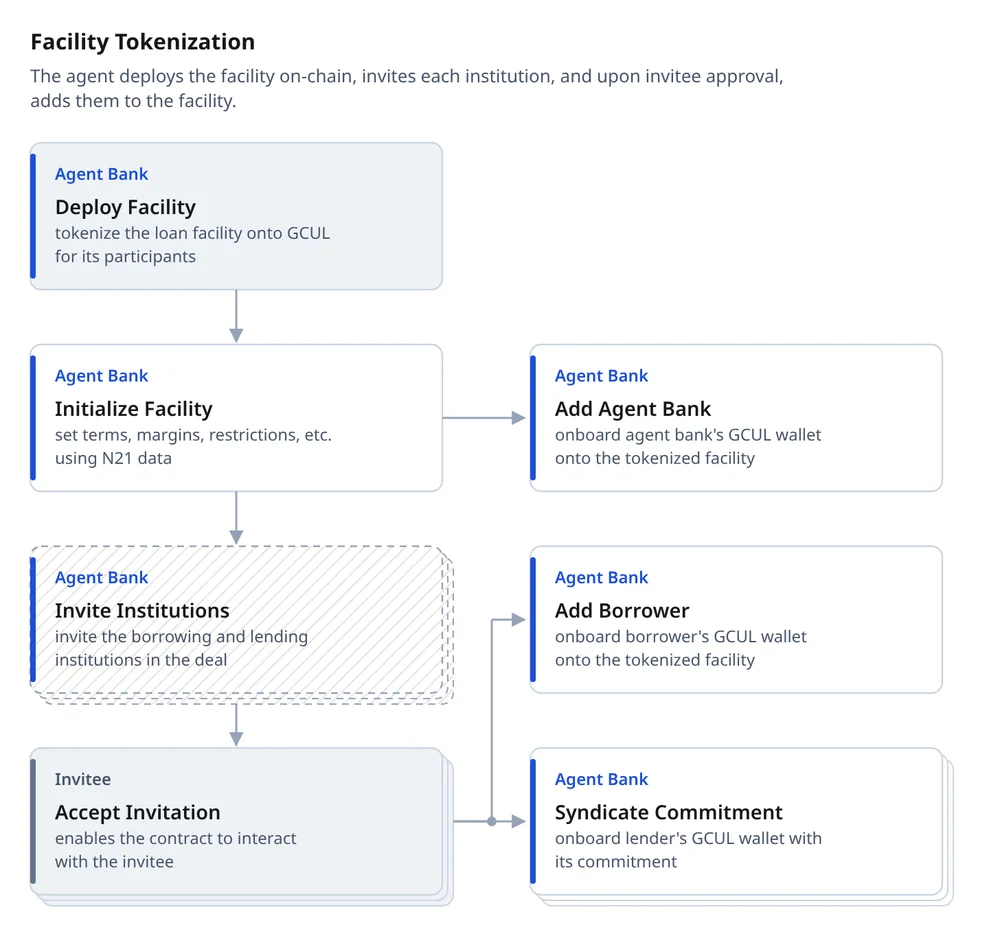
Participants were onboarded through an invitation process. Each party reviewed the request and approved it through its own interface, making participation dependent on explicit consent. After onboarding, the agent bank recorded an immutable hash of key loan terms on the ledger. The hash served as an attestation that the on-ledger representation matched the canonical records held off-ledger.
This approach puts shared verification alongside workflow automation. A common record can reduce the scope for inconsistent versions of loan data, while the recorded hash gives participants a way to check the relationship between the ledger and the underlying agreement. The proof of concept doesn’t establish how much time or cost this would save in production, but it shows how agreement data could anchor operational actions.
Transfers and payments become coordinated workflows
The same consent model applies after onboarding. A secondary market transfer, for example, requires approval from the incoming lender, borrower and agent bank before the position can move. Once the required permissions are in place, the transfer executes atomically on the ledger. The workflow is designed to make consent part of execution, rather than a separate coordination step that must later be reconciled against the transaction record.
Payments also run through GCUL in the demonstration. Interest payments and loan close-outs settle on-ledger using tokenized commercial bank money, avoiding the need for external payment rails within the modeled process. Keeping payment and loan state in the same environment could make it easier to verify that the movement of funds corresponds to the relevant facility event.
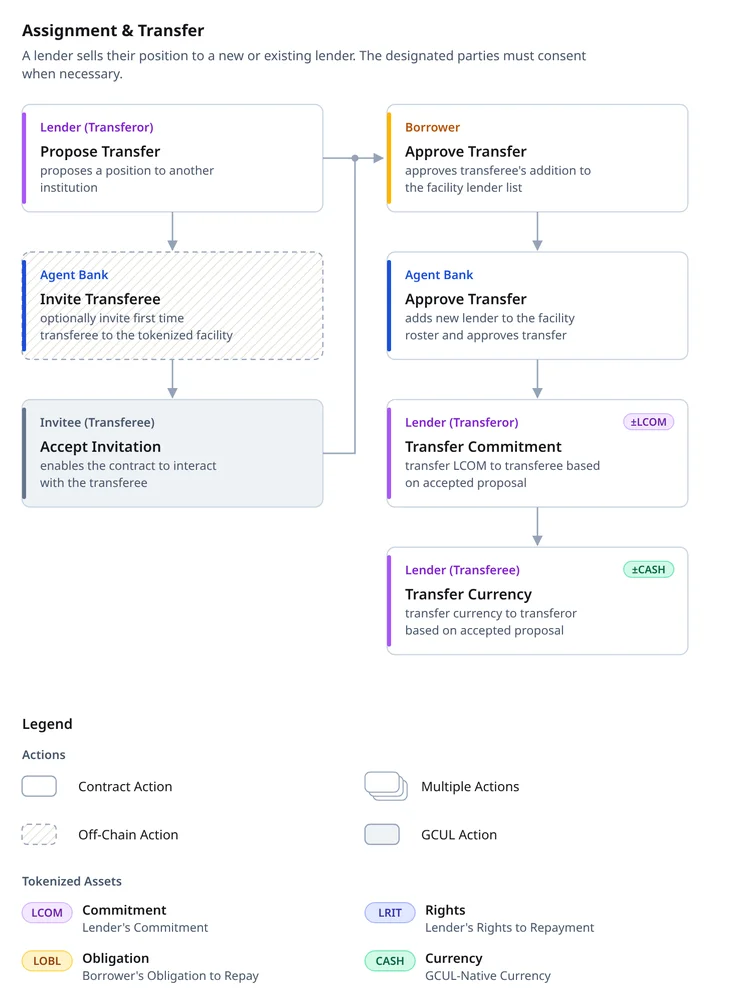
For an institutional deployment, the mechanics matter as much as the ledger itself. Nammu21’s contracts check proposed actions against terms derived from the credit agreement before execution. That gating is intended to catch actions that conflict with the agreement, such as an invalid transfer or a potential covenant breach, before they complete.
GCUL’s permission controls address another operational concern: who can see or act on sensitive information. Role-based access limits visibility to the counterparties who need it, helping keep positions, trading strategies and loan data private within a multi-party transaction. GCUL also requires users to authorize a contract before it can store data on their behalf, which helps institutions control which assets and contracts they interact with.
Language and controls for institutional workflows
GCUL contracts are written in gculpy, a strict, statically typed subset of Python designed for financial logic. The language is intended to make contracts readable and auditable. Its constraints also reduce some development burdens: engineers don’t need to manage memory manually or work around highly restrictive call stack limits, according to the project description.
Those properties support the larger design goal: encode loan rules in a form that can be checked consistently as transactions happen. A ledger can record events, but the value of this implementation depends on how accurately the DCI captures the legal agreement and how faithfully the generated contract applies it. The link from each structured term back to its source provision gives the model an explicit reference point for that work.
The project rests on three connected ideas: contracts check actions against governing terms; permissioning controls access to loan information; and ledger execution provides near-instant finality for recorded actions. Together, these features aim to replace provisional records and later reconciliation with shared, verifiable state.
What the proof of concept suggests
Nammu21 and Google Cloud frame the project as a way to change how loan operations are coordinated, rather than simply digitizing existing documents. If terms can be represented consistently and applied during transfers and payments, participants may spend less time resolving differences in interpretation and matching records across systems. Faster settlement could also leave less capital tied up while a trade completes.
The demonstration focuses on one modeled Term Loan B, so it does not establish that every agreement or market workflow is ready for this approach. Loan documents vary, and the operating model depends on accurate term extraction, participant consent and integration with existing records and payment processes. Still, it illustrates a practical path: make the agreement’s rules machine-readable, preserve their connection to the source text, and use them to control lifecycle events.
That pattern could apply to other forms of credit where bespoke terms are interpreted manually. The near-term takeaway is a concrete architecture for bringing document logic, transaction permissions and settlement into a coordinated workflow. Its broader value will depend on whether institutions can apply that model across more facilities and counterparties.