HashiCorp Secure Hub Adds Enterprise-Wide Governance for Vault
As organizations spread HashiCorp Vault across applications, regions and business units, managing each deployment on its own leaves a wider operational question unanswered: what’s happening across the estate? Secure Hub, now in public preview, adds a shared governance layer that gives teams a broader view of Vault environments and the security resources within them. That view addresses a familiar operational problem: local teams may understand their own deployments while central platform or security teams struggle to assemble a consistent picture across the organization. A shared view can make it easier to notice differences and coordinate follow-up, though its value will depend on what teams can see and how they use that information.
The distinction matters. Vault Enterprise continues to enforce access controls inside each environment; Secure Hub gathers operational and reporting context across them. That gives platform, security and governance teams a way to assess distributed deployments together while retaining the controls suited to each environment. In practice, central visibility and local enforcement solve different problems: one helps teams understand the broader estate, while the other governs activity where resources are managed. Keeping those roles distinct may suit organizations that need shared oversight without imposing identical operating rules on every team.
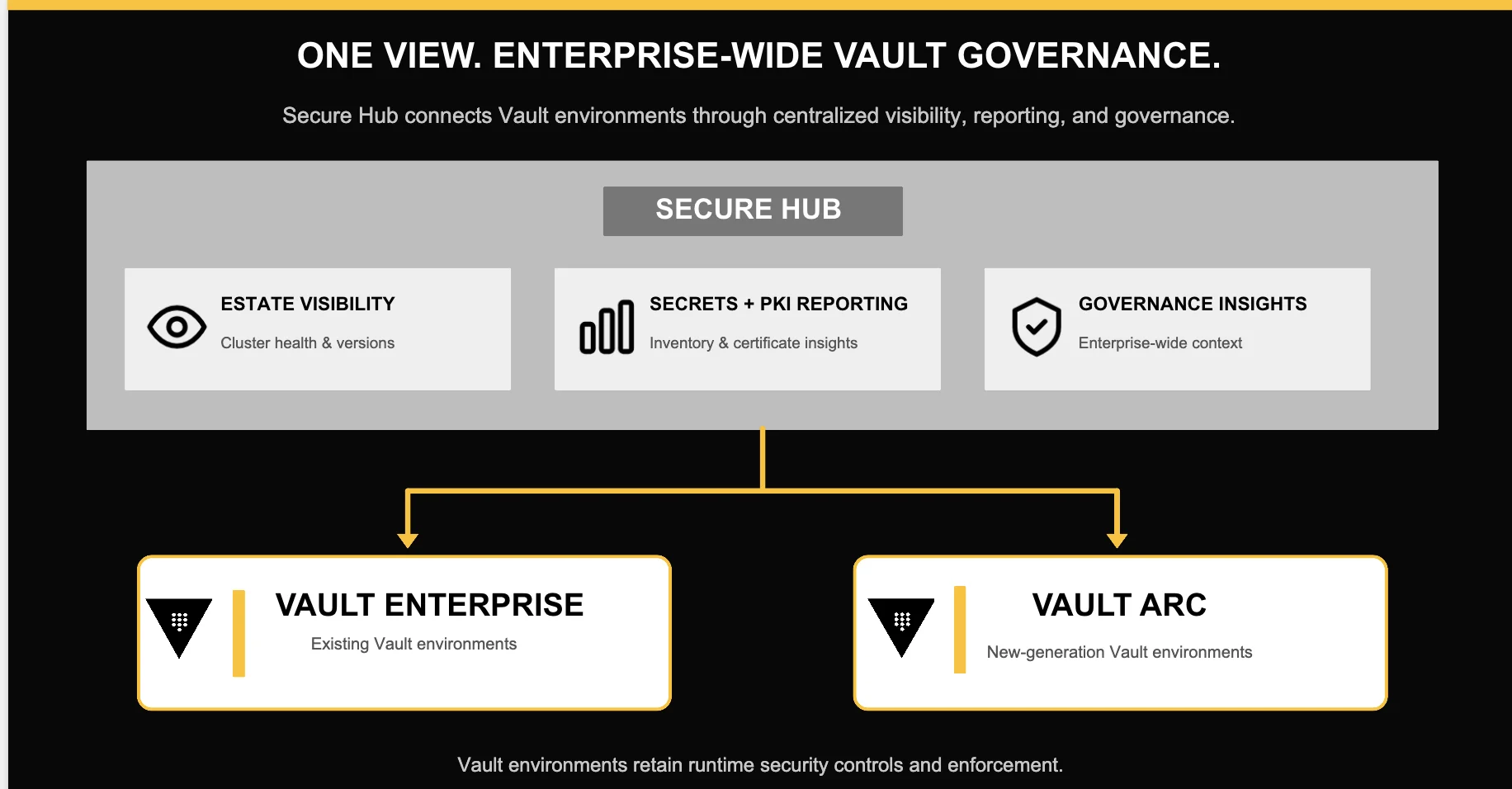
One view across distributed Vault environments
Vault deployments often grow as new teams adopt secrets management, PKI and related services. What starts as separate environments for particular applications or regions can become a portfolio that’s difficult to monitor consistently. Each deployment may have its own configuration, usage patterns and operational needs, which makes comparisons harder when information is gathered by hand. Secure Hub is designed to bring those deployments into a common governance experience, with visibility into:
Cluster health and configuration. See operational health, configuration and software versions across environments, helping platform teams understand the state of their Vault estate. A shared view can help identify where teams may need to investigate or compare settings. It won’t, by itself, explain why a cluster differs or determine what action is appropriate; that still depends on the organization’s operating standards and context.
Secrets activity. Review the types of secrets present in different environments and when they were modified or used. This information can help teams monitor practices and address governance or audit needs. The practical benefit is a broader record to review when teams need to understand activity across organizational boundaries. Its usefulness will depend on how the information fits into existing review processes.
Certificate lifecycles. Track issued and expiring certificates across the estate to spot upcoming lifecycle events and coordinate renewals. That can help teams plan work across deployments instead of treating every certificate as an isolated task. Certificate visibility also gives platform and security teams a way to see where lifecycle responsibilities sit, especially when multiple teams manage separate environments. Timing and ownership still need to be handled by the teams responsible for those systems.
Governance across environments. Build enterprise-wide visibility while keeping the policies and enforcement appropriate to each deployment. This distinction matters for organizations whose teams have different operational requirements or security boundaries. A shared view can support oversight without requiring every deployment to be operated in exactly the same way. The challenge is making that visibility useful to people who have different responsibilities.
Resource Unit consumption. Track usage by cluster and namespace, giving teams a clearer view of licensing consumption. Breaking usage down this way can help teams connect consumption to the parts of the estate where it occurs. That context may be useful for internal planning and discussions about how Vault is being used. The numbers here are underwhelming as a standalone feature, but they become more meaningful when considered alongside deployment health and organizational ownership.
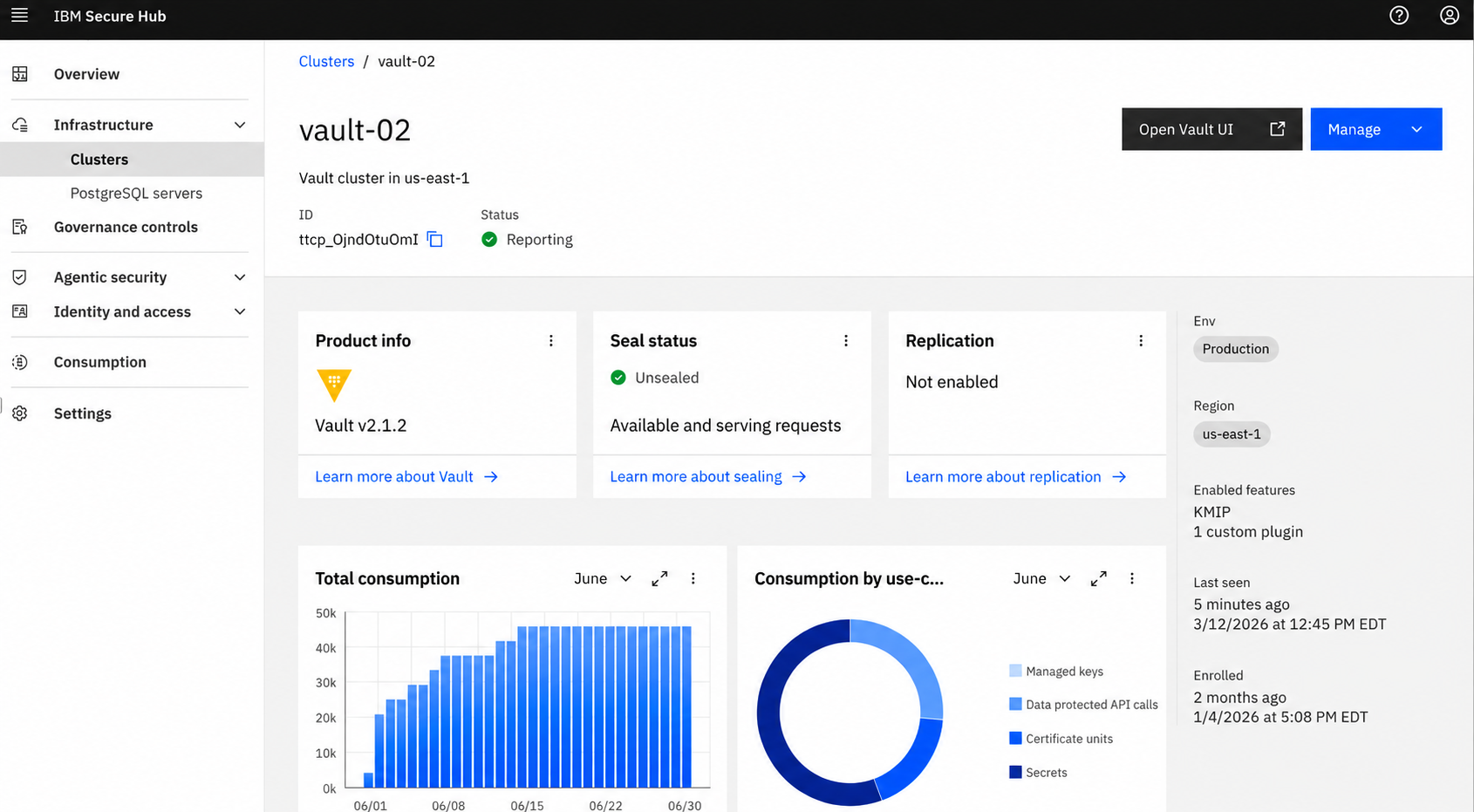
Works with existing Vault Enterprise deployments
Secure Hub is aimed at organizations already running Vault Enterprise. They can add reporting and governance across teams, regions and use cases while building on their existing deployments and operating practices. That could lower the effort involved in getting a broader view, since teams can begin with environments they already manage rather than making a new product a prerequisite. But the public preview is also the point at which customers can assess whether the available information maps to the way their own teams divide responsibility.
It’s also designed to support Vault Arc, giving organizations a route to govern both Vault Enterprise and the newer offering as their environments change. Vault Arc isn’t required to use Secure Hub; teams can start with the Vault Enterprise deployments they have today. That flexibility leaves room for organizations to evaluate the shared governance layer without first changing their deployment plans. If you’re working in this space, the question to examine is whether the combined view helps your teams coordinate work across environments they already operate.
Governance across the security lifecycle
Secrets, certificates and cryptographic assets don’t exist in isolation. Teams need to understand how these resources are created, used, governed and retired across environments and organizational boundaries. Secure Hub extends Security Lifecycle Management beyond individual Vault deployments, bringing that enterprise-wide view into focus. The broader framing matters because a credential’s lifecycle can involve more than the system that stores it: teams may need to know where an asset is present, who manages the environment and when it needs attention. A central view can help connect those questions, provided the underlying reporting gives teams enough context to act.
That scope may matter more as machine identities grow and organizations adopt agentic AI. More identities bring more credentials, certificates and access relationships to track. Secure Hub is intended to help teams see those resources across a distributed Vault estate and govern their lifecycle at scale. Here’s the thing: visibility is only the starting point. Organizations will still need clear ownership and processes for reviewing what they see, particularly when resources span teams with different responsibilities. More to track, and more people who need to understand it (and this is the part most people overlook).
HashiCorp positions Vault Enterprise, Vault Arc, Secure Hub and capabilities from IBM’s broader security portfolio as a foundation for discovering, securing and governing human, machine, workload and agentic access. The public preview gives customers a chance to assess Secure Hub’s approach and share feedback as the product develops. That said, the announcement describes an intended role for the product, not a demonstrated outcome for every organization. The useful test will be whether teams can turn the shared reporting into clearer decisions and coordinated work across their actual deployments.
What the public preview needs to prove
A central governance view is most useful when it helps teams answer practical questions: which environments need attention, where are resources changing, and who should respond? Secure Hub’s listed views speak to those needs, but organizations will have to judge whether the information is timely and detailed enough for their workflows. They’ll also need to consider how the new view fits with the tools and routines they already use to monitor Vault.
For customers, the preview is an opportunity to compare the product’s stated scope with the day-to-day work of managing a distributed estate. If the reporting connects deployment health, secrets activity, certificate lifecycles and consumption in a useful way, it could make cross-team oversight less fragmented. If it doesn’t, a broader dashboard alone won’t resolve gaps in ownership or process. The test is whether teams can act on what they see.
Join the HashiCorp Secure Hub public preview to explore its capabilities and provide feedback.
Learn more about the SLM announcements at TechXchange.