Terraform Adds Policy, Search and Agent Workflows for Governed Infrastructure Operations
Terraform’s latest capabilities point to a broader shift in infrastructure management: AI agents are beginning to participate in delivery and operations, so teams need controls that span the full lifecycle. Automating an isolated task won’t be enough if agents can’t work from trusted infrastructure context, follow approved workflows and understand the consequences of a change.
At HashiConf at TechXchange, HashiCorp introduced a set of Terraform capabilities aimed at that problem. They range from policy authoring and discovery of unmanaged resources to governed self-service, remote access for AI agents and infrastructure intelligence. Availability varies: Terraform policy is generally available; enhanced search with Terraform policy, Terraform Developer Portal and Remote Terraform MCP server are in public preview; intent-driven workflows for Z and LinuxONE are in private preview. HCP Terraform powered by Infragraph brings infrastructure data and lifecycle context together as near-real-time intelligence.
My read is that the value lies in connecting these pieces. Teams can define what’s approved, make those patterns available to developers and agents, then use infrastructure relationships and governance data to inform operations at scale.
A shared foundation for infrastructure work
Terraform frames this lifecycle in three stages: define, consume and scale. In the first, platform teams encode infrastructure patterns, policies and operational standards. In the second, developers and agents use those patterns through governed self-service. In the third, connected infrastructure intelligence helps teams continue to govern and operate as environments change.
The model addresses a practical gap in task-level automation. An agent may be able to generate code or request infrastructure, but organizations still need a way to establish which patterns are approved, apply existing permissions and policies, and give people and agents enough context to make informed choices. Terraform’s announcements extend its role across those stages.
Policies and discovery move closer to the workflow
Terraform policy is now generally available as a declarative, HCL-based policy-as-code framework. Bringing policy authoring and enforcement into Terraform gives teams a way to work with a language practitioners already use, rather than managing governance through a collection of disconnected tools and policy languages.
The framework can evaluate relationships between resources, use data source lookups, govern provider and module downloads, and check policies both before and after deployment. That lifecycle coverage matters as infrastructure becomes more interconnected: a policy decision may depend on how resources relate or what data is available, not just on a single resource in isolation.
HashiCorp also points to tools intended to help teams create and adopt policies. The tfpolicy agent skill supports writing and testing policy files with a coding agent. A conversion agent is designed to convert Sentinel and OPA policy libraries into tested Terraform policies. Teams can also browse HashiCorp-managed policies through the native pre-written policy experience in HCP Terraform.
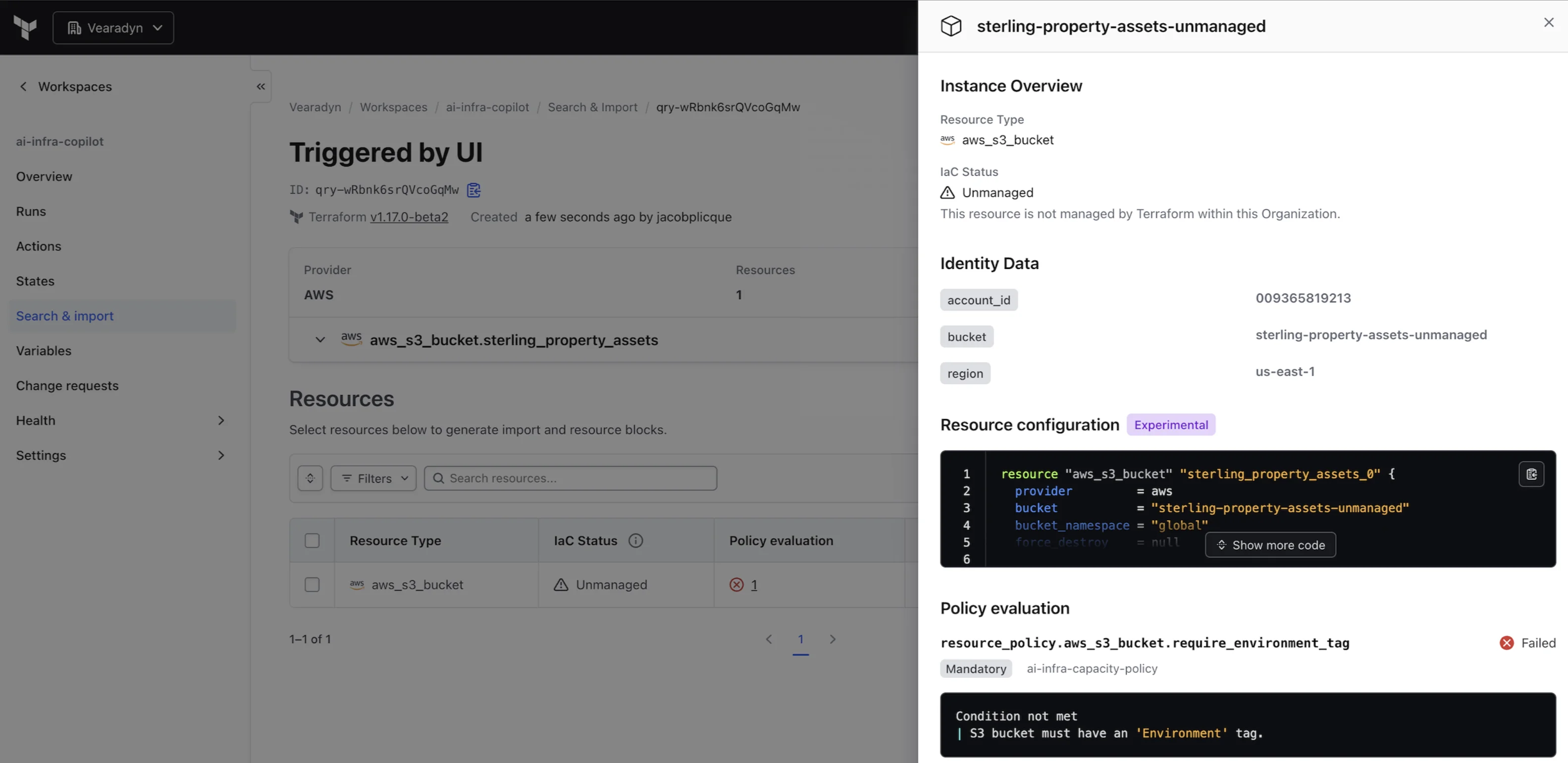
Policy checks are most useful when teams know what infrastructure exists in the first place. Terraform introduced Terraform search to help find resources that weren’t created or managed through Terraform. The new public preview of enhanced search with Terraform policy adds an interactive search experience and compliance visibility before resources enter Terraform management.
Previously, users had to write queries manually, and the compliance status of unmanaged resources could remain unclear because policy enforcement applied to Terraform-managed infrastructure. That gap could leave platform engineers importing resources without knowing their status, developers encountering policy failures later, and policy administrators without a clear view of governance coverage.
The updated workflow lets teams discover resources, evaluate compliance and send compliant resources toward import. Resources that fail policy checks can be flagged for remediation before the import proceeds. The practical benefit is earlier visibility into governance issues, reducing the chance that unmanaged infrastructure becomes a surprise later in the Terraform workflow.
Self-service and agent access share Terraform controls
Terraform Developer Portal, now in public preview, extends HCP Terraform into governed self-service. Platform teams can define approved infrastructure patterns, then make them available to developers and AI agents through the interfaces where they already work. The aim is to reduce repetitive requests and manual handoffs while keeping governance, identity, policy, execution and automation within HCP Terraform.
This design also addresses the growing overlap between developer tools and infrastructure operations. When agents begin provisioning infrastructure or helping teams deploy services, organizations need those agents to use the same approved patterns and controls as developers. A shared self-service path gives platform teams a way to serve more users and workflows without maintaining a separate portal layer.
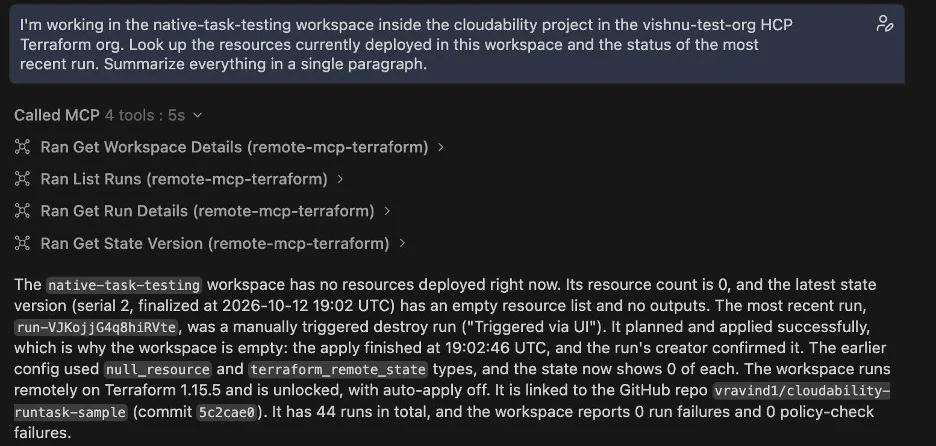
The Terraform Developer Portal is one part of that approach. The other is a direct connection between agent tools and Terraform workflows. Terraform MCP server lets assistants such as IBM Bob, Claude Code, GitHub Copilot and Cursor discover approved modules, generate infrastructure code aligned with organizational standards, analyze plans in natural language and access workspace information.
Those actions use Terraform’s existing authentication, permissions and governance controls. The MCP server became generally available earlier this year. Its remote version is now in public preview for HCP Terraform, removing the need for developers to install and maintain the server locally.
Infrastructure intelligence for larger operations
For mission-critical systems, the challenge includes operational knowledge as well as workflow design. Terraform intent-driven workflows for Z and LinuxONE, in private preview, bring discovery, rehearsal and simulation into Terraform workflows through a conversational interface. The capabilities are built for Terraform on Z, pairing those steps with enterprise guardrails and governance.
That focus addresses a specific operational constraint: expertise can be concentrated among a shrinking pool of specialists, while changes to mission-critical infrastructure carry significant risk. Encoding operational knowledge in repeatable workflows may help teams onboard people, adopt Infrastructure as Code and carry out work more consistently. The preview extends Terraform automation to Z and LinuxONE environments with discovery and rehearsal as part of the process.
HCP Terraform powered by Infragraph adds another layer: connected context about infrastructure resources, their relationships, governance and lifecycle. Terraform already produces domain-specific infrastructure data; Infragraph turns that information into near-real-time intelligence. People and agents can use it to understand what exists, how resources connect, what has changed, which assets are governed or unmanaged, and where an action may carry risk.
That context is what makes scaling automation more credible. An agent that can act but can’t see how infrastructure fits together has limited grounds for making a sound decision. Connected data gives teams and agents a clearer basis for evaluating changes across an environment.
The lifecycle is the product direction
Taken together, these releases extend Terraform from infrastructure automation toward a lifecycle model that links policy, discovery, self-service and operations. The defining idea is that humans and agents should work from the same infrastructure context and within the same governed workflows, whether they’re defining a pattern, requesting a resource or assessing an operational change.
That direction will depend on how well these capabilities work together in practice, particularly as the preview features mature. For infrastructure teams, the near-term takeaway is concrete: policy checks can reach further into Terraform workflows, unmanaged resources can be assessed before import, and agents can access Terraform through governed connections. The next test is whether that shared foundation gives teams enough context and control to expand agent participation safely.
Organizations can explore HCP Terraform or contact HashiCorp for more information.