Zest Brings Restaurant Discovery and Reservations to Text Messages
From restaurant search to a reservation
Zest is moving restaurant discovery into the messaging thread, where recommendations can lead directly to a reservation. Its new AI concierge draws on diners’ past restaurant spending to suggest places, check availability and book through services including OpenTable, Resy and SevenRooms. The pitch is straightforward: a person can ask for a place to eat in the same setting where they’re already coordinating with friends, then continue through to a booking without switching into a separate search flow.
That makes the shift more than a new way to browse. Zest is betting that an agent grounded in a person’s actual dining history can handle the full path from “Where should we go?” to a confirmed table, without requiring another app session. That’s a more demanding job than producing a list of nearby restaurants. A useful concierge has to interpret preferences, account for practical constraints and turn a group’s changing conversation into an action. The test won’t be whether it can produce plausible suggestions; it’ll be whether the recommendations and booking steps hold up when people are making real plans.
Recommendations drawn from real dining history
Founded in November 2024, Zest connects users’ credit cards through Plaid to identify transactions in food and drink categories. It uses that information to build a personalized map and lists, then recommends restaurants in users’ home cities or while they travel. The approach gives the service a record of where someone has actually spent money, which can provide a different signal from a profile built only from stated favorites or a string of prompts. Spending history still has limits: a transaction can show that someone visited a place, but it can’t explain whether they loved it, went for convenience or were there because someone else chose it.
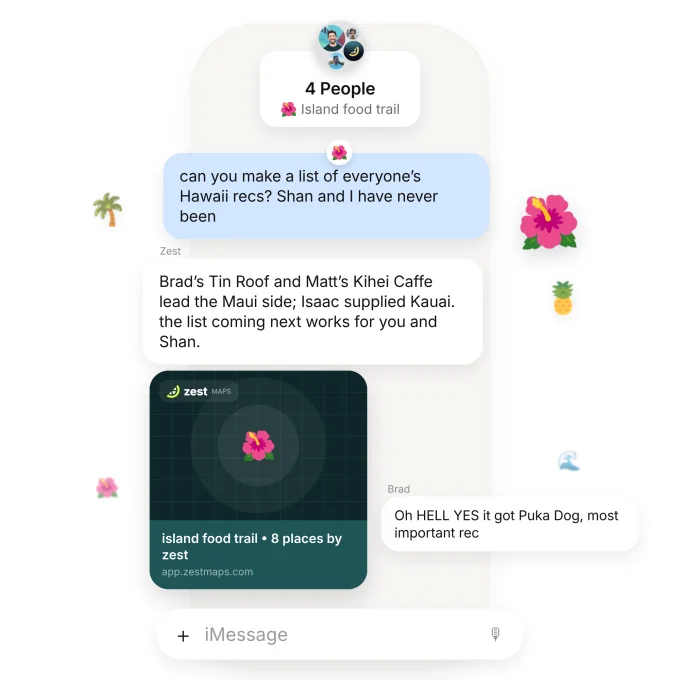
Founder and CEO Mario Gomez-Hall says the concierge starts with that existing history, including friends’ preferences, instead of learning through weeks of conversation. “The agent is the product now,” he said. “You text it, and it answers from your own history and your friends’.” The friend component matters because restaurant choices often happen across a group, not in isolation. But it also makes the quality of the underlying preference signals important: if the system misunderstands what a person liked, its confident recommendations could make a group decision harder rather than easier.
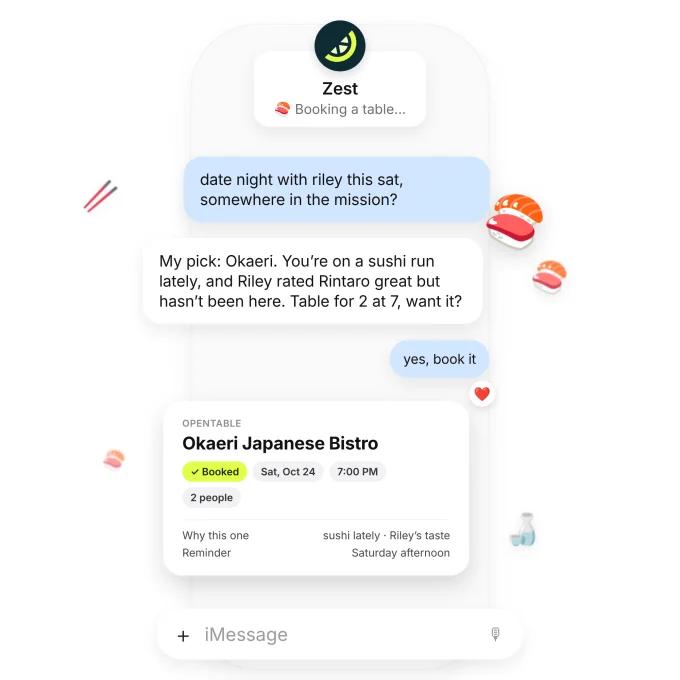
Users can message Zest at (212) 470-6067. They can filter suggestions by cuisine, craving, occasion, dietary needs or neighborhood, and ask practical questions about a restaurant, such as whether it has Wi-Fi or how busy it might be. The concierge can also send menus. Those options suggest a product intended to handle the messy details that usually follow an initial search: narrowing the choices, checking whether a place fits the occasion and giving the group something concrete to react to. The value will depend on how well it answers those questions, especially when a request combines several constraints.
Group decisions and bookings in one thread
Zest is built for group chats as well as one-to-one requests. It can weigh participants’ tastes, let the group vote on options and then make a reservation from the same conversation. That combination targets a familiar snag in dining plans: getting from a shortlist to a choice everyone accepts. The group format is a sensible focus because the person who finds a restaurant isn’t always the person who gets everyone to agree on it. A shared thread can keep preferences, suggestions and the final decision together, though the service still has to make its choices clear enough for people to compare.
In TechCrunch’s testing, Zest returned unfamiliar restaurants that fit constraints including time, party size and location. Finding open tables is already common across booking apps; the useful difference here is being able to discuss options by text and get available booking times in the conversation. That’s a modest but meaningful distinction. Search and booking tools have long handled individual steps, while Zest is trying to connect them to the social negotiation that happens before a reservation is made. This is more significant than it looks if the conversation itself is where plans usually stall.
The company began testing the concierge the previous month and held its release until it could add reservations. The app launched earlier this year, and Zest now hopes messaging will help it grow beyond its initial thousands of users. Adding booking before release gives the concierge a clearer endpoint: it can move from suggestion to a confirmed table, rather than leaving users to restart the task elsewhere. Still, early testing and an initial user base don’t establish how often people will rely on the service or whether they’ll return after trying it.
A messaging interface with a business model
Zest was founded with $1.8 million in pre-seed funding from Alexis Ohanian at 776 and Steve Jang at Kindred Ventures. Gomez-Hall says bookings and, later, food ordering are the company’s first revenue opportunities. Zest currently books through OpenTable or Resy, with ordering still to come. That puts the business case close to the product’s main promise: helping users choose a place and complete a transaction. But the company’s ability to turn that convenience into revenue will depend on whether the service can attract repeated use, not simply on whether it can complete a booking.
The company is also considering recommendations beyond restaurants, including businesses and shopping. For now, the product’s clearest case is dinner: use a record of where people already eat to make suggestions more relevant, then carry the decision through to a booking. Here’s the thing: adding more categories could broaden what the concierge can do, but it could also make its purpose less easy to understand. The restaurant use case gives Zest a concrete problem to solve and a visible finish line—a reservation in the thread. If you’re working in this space, that’s the part to watch: whether users trust a messaging agent with the details of their plans, and whether the service makes the decision easier for the whole group.
And yet, the convenience rests on a personal data source: connected card transactions. Zest’s recommendations may be more tailored because they draw on dining history, but users still have to see enough value in that personalization to connect their cards and keep using the service. (And this is the part most people overlook.) Better suggestions are only one piece of the experience; the system also needs to understand the context behind a request and make its limits apparent when it can’t answer confidently. A useful concierge. A harder product to get right than a chat window suggests.