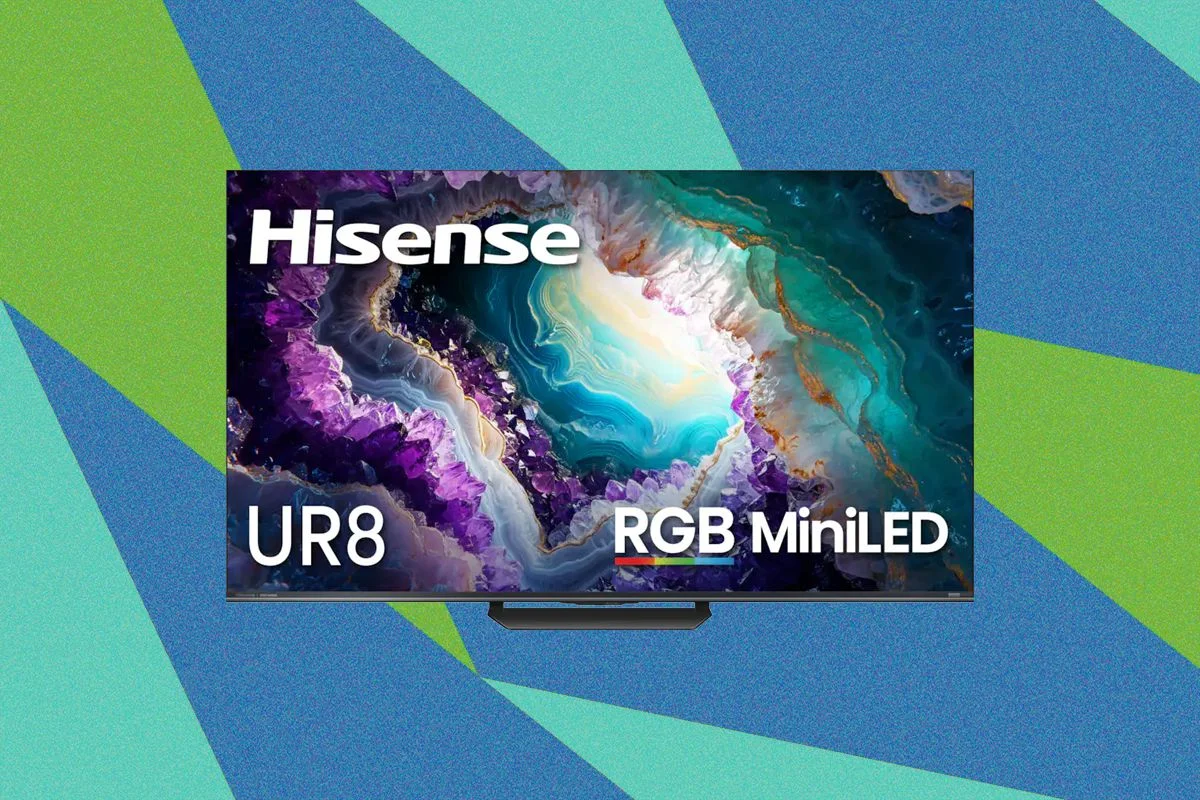
The Hisense UR8 RGB MiniLED makes a persuasive case for spending less on an RGB TV: Its color is accurate and vivid, and its price sits below higher-end rivals. The trade-off shows up in brightness and dark-scene contrast. That’s a meaningful compromise, especially if movies are your main reason for upgrading.
After reviewing several leading RGB TVs, including Hisense’s flagship UR9 RGB MiniLED and models from Samsung and LG, I’d call the UR8 a solid, if limited, entry in the category. It delivers mini RGB technology for less than the impressive UR9. The color accuracy can be striking; the panel simply doesn’t match its sibling’s brightness or contrast.
RGB TVs let you adjust the picture to bring out more vivid, accurate color. The UR9 proved stronger across films, shows, games, and artwork, but the UR8 still produces a colorful image and adds low-latency gaming, easy setup, and a more accessible price. Whether those savings justify its weaker performance in some dark scenes depends on what you watch. There’s no universal answer.
Setup and design
The UR8 is thicker than the UR9, though the two look much alike: both have a similar chassis and a single pedestal stand. The stand clicks into place and needs a few screws, but assembly is quick and uncomplicated. Getting started is simpler still: scan a QR code to connect through Google Home, then follow the setup prompts.
The UR8 earns a 7/10. Its strengths are accurate color for movies, shows, and games; a comparatively affordable price for an RGB TV; low-latency gaming; and easy setup. Its weaknesses are less brightness than some RGB competitors, muddy or unclear dark scenes, and merely average built-in speakers.
The UR8’s color credentials are impressive, but its lower brightness shows up in real viewing. It reaches about 3,500 nits, compared with 5,000 on the UR9, and dark scenes often lose detail as a result. The UR8 does offer four HDMI 2.1 ports to the UR9’s three; the UR9’s extra USB-C port, intended for low-latency gaming, made little difference in my use.
The UR8’s internal audio is a step down, too: its 2.1.2 speaker system has two main channels, a subwoofer, and two height channels, while the UR9 adds a side channel for a 4.1.2 setup. If you already use a soundbar or receiver, that gap matters less. Both sets support Dolby Atmos and eARC passthrough.
Size may settle the choice for some buyers. The UR8 comes in 55 inches, while the UR9 starts at 65 inches; both also come in 75-, 85-, and 100-inch versions. They share a remote with a well-placed Home button, a Mute button tucked awkwardly at the lower right, and a backlight. The Kidoodle.TV shortcut is a puzzling addition.
Color Is the UR8’s Case
Micro and mini RGB TVs use red, green, and blue backlights instead of shining white or blue light through a color filter and LCD panel. That approach can produce vivid, realistic color in bright rooms. The UR8 backs up the promise on paper: it covers 100 percent of the BT.2020 specification and is [Pantone Validated](https://www.pantone.com/na/en-us/license/about-pantone-validated). It also supports [Wi-Fi 6E](https://www.wired.com/story/what-is-wi-fi-6e/) for streaming. Its ports sit on the left: Ethernet, optical audio, coaxial, and one USB-A for storage or an HD antenna.
But accuracy doesn’t guarantee convincing contrast. In *Awake* on Netflix, a bike scene was nearly black in Dolby Vision Reference and standard Dolby Vision modes. Raising brightness in a custom Dolby Vision setting helped, though the image remained murky.
The same pattern emerged across other films. Dragon scales in *House of the Dragon*, streamed through HBO Max via Google Cast, were visible but less textured than on the UR9. A beach landing in *The Creator* looked dim and washed out; gunfire in *The Batman* was bright, but lacked fine detail. The UR8’s ceiling is clearest in dark material.
Colorful scenes make a stronger argument for this set. In *The Super Mario Galaxy Movie* on Peacock, rainbow stars looked bright and accurate, though some produced halos as light spilled into darker areas. The UR9 showed similar blooming. *Guardians of the Galaxy Vol. 2* on Disney+ delivered vivid blues, reds, and oranges with striking realism, but the UR8 couldn’t match the UR9’s tonal contrast or shadow detail. The [LG Micro RGB Evo](https://www.wired.com/review/lg-micro-rgb-evo/) made that scene brighter still.
The [Spears & Munsil discs](https://www.wired.com/about/faq/) told a similar story. Skin tones looked dimmer and less varied than on the LG or UR9. White mist against a white mountain was harder to distinguish than on the UR9, while green grass beside a fence looked much the same on both sets. At night, the UR9’s extra brightness revealed more in the trees; the UR8 still showed texture, but rendered a red cactus and yellow flower more darkly.
A Better Fit for Games
Gaming is where the UR8 feels closer to its more expensive sibling. It detects games and adjusts picture settings for latency and image quality. *Resident Evil: Requiem* looked dark and atmospheric without appearing washed out, and I noticed little latency difference versus the UR9—Hisense representatives said the two were roughly on par.
On Xbox Series X, *Senua’s Saga: Hellblade II* made ocean-side rocks look startlingly lifelike as they caught ambient light. *NBA 2K27*, with DLSS 5 enabled, showed crisp detail and vivid color, with some players looking remarkably realistic.
The UR8’s speakers have less presence than the UR9’s, though they still deliver a satisfying thump in action scenes. The sets share other features, including Google Gemini voice suggestions and AI-generated slideshows, motion smoothing that worked well for games and movies, and ambient-light adjustment. Artwork also looked richly textured and bright.
The UR8 delivers the central appeal of RGB: unusually convincing color. Its weaker brightness and shadow detail are real compromises, especially if dark films are a priority. If you can live with those limits, the UR8 looks like a worthwhile way to get the technology without buying the flagship.
[Photograph: John Brandon](/articles/9333/86djJopkK1JtQCnmk5q5Q39ND1SPXTN2.webp)
[Photograph: John Brandon](/articles/9333/vBo8bTSBniiyMQHAqTwmelxdWNgd0vvw.webp)
[Photograph: John Brandon](/articles/9333/zJzDWKnlzINmmzCV0Q8wsIhJK3JruUdm.webp)
[Photograph: John Brandon](/articles/9333/5MAoEhNUeZAGIRJHnVeYXlwKCAeFemvn.webp)
[Power up with unlimited access to WIRED](https://www.wired.com/v2/offers/wir_generic_ctrl?source=Site_0_HCL_WIR_EDIT_HARDCODED_0_COMMERCE_AFFILIATE_ZZ). Get best-in-class reporting and exclusive subscriber content. [Subscribe today](https://www.wired.com/v2/offers/wir_generic_ctrl?source=Site_0_HCL_WIR_EDIT_HARDCODED_0_COMMERCE_AFFILIATE_ZZ).