Google Cloud Launches Self-Managed VMware Cloud Foundation on Bare Metal
|5 min read
Google Cloud adds a more hands-on route for VMware customers
The key change in Google Cloud’s new VMware offering is who gets to run the virtualization stack. Many organizations want to move VMware workloads out of their data centers, modernize critical systems, or use the cloud for disaster recovery. They may still want to keep their existing operating procedures. Google’s new self-managed option is aimed at that gap.
Now generally available as part of the
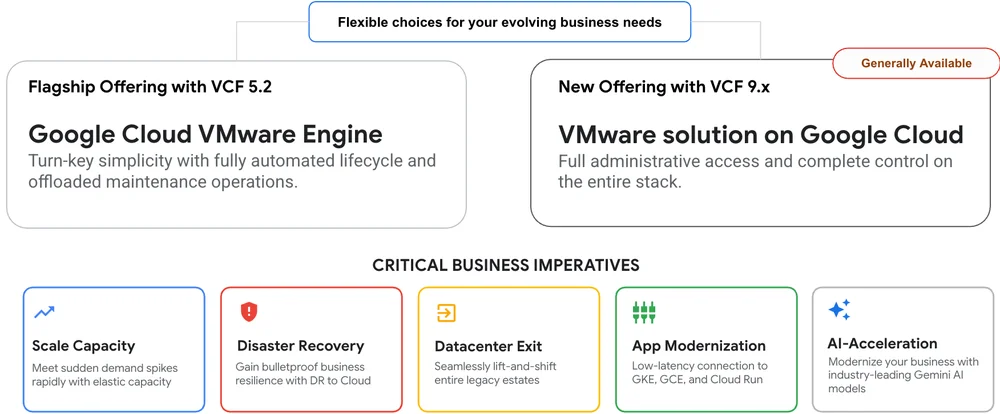
VMware solution in the Google Cloud Modernize portfolio, the service runs VMware Cloud Foundation (VCF) on dedicated Google Cloud bare metal and gives customers full administrative authority. It sits alongside Google Cloud VMware Engine, Google’s existing managed service, giving organizations a choice between Google-run operations and direct control over their VMware environment.
That distinction matters for teams with established maintenance windows, internal virtualization expertise, or third-party monitoring and management systems they need to preserve. They can manage the stack themselves and customize it to fit those practices. Broadcom’s launch of VMware Cloud Foundation 9.x helps explain the timing: its unified control plane is designed to handle deployment and lifecycle management across the VCF stack, while letting customers use Broadcom’s latest features and existing VCF licensing.
Broadcom’s Abhay Kumar, global head of hyperscalers for the VMware Cloud Foundation Division, said customers can bring portable VCF subscriptions, keep VMware workloads unchanged, and use Google Cloud commitments and discounts on dedicated Z3 bare metal. That’s an appealing combination on paper. The trade-off is familiar: customers gain control and choice, but also take on more responsibility for operating the platform.
Two operating models, with different levels of control
Google Cloud VMware Engine is positioned for teams that want turnkey operations and Google-managed maintenance. It uses VMware Cloud Foundation 5.2, offers role-based vCenter administrative privileges, and runs on VMware Engine ve1 and ve2 node families. Google handles automated patching, updates, and monitoring.
The new VMware solution targets teams that want to customize and own more of the stack. It runs VCF 9.x on dedicated Compute Engine bare metal, including Z3 instances, and provides root access across ESXi, vCenter, NSX Manager, and other VCF components. Customers or partners manage updates using VCF Operations Management tools. Both services support bring-your-own, portable VCF subscriptions.
Z3 bare metal brings compute, storage, and networking together
The self-managed deployment uses the `z3-highmem-192-highlssd-metal` instance type, powered by 2.2 GHz fourth-generation Intel Xeon processors, code-named Sapphire Rapids. Each node has 96 physical cores, or 192 hyperthreads, 1.5 TB of RAM, 72 TB of all-flash NVMe storage, and 200 Gbps networking.
Running natively alongside Compute Engine and Google Kubernetes Engine (GKE) gives the VMware environment access to Google Cloud services, including BigQuery, the Gemini platform, and Cloud Run. Google says the architecture offers high-bandwidth, low-latency networking for transactional databases. The practical value will depend on the workloads and how they connect to those services; the platform description alone doesn’t establish the performance customers will see.
Storage is built around VMware vSAN hyperconverged infrastructure and the Z3 nodes’ NVMe drives. Those drives can also serve as a memory tier, and the solution supports NetApp volumes as an external datastore. NetApp’s Pravjit Tiwana, senior vice president and general manager of Cloud Storage, described that option as a way to retain familiar data management and performance capabilities while moving VMware workloads and data to Google Cloud.
Cost claims hinge on how customers use the hardware
Google’s economic case combines portable Broadcom VCF subscriptions with Google Cloud commitments and Flexible Committed Use Discounts (Flex CUDs) for Z3 bare metal. It also points to three possible sources of savings: NVMe memory tiering between DDR memory (Tier 0) and local NVMe (Tier 1), which Google says can cut server total cost of ownership by up to 40%; vSAN Express Storage Architecture (ESA), which it says can reduce storage TCO by up to 39% compared with traditional external arrays; and active live patching, which can cover up to 80% of critical security updates and reduce planned maintenance downtime.
Those are maximum stated savings, not guaranteed outcomes. Actual results will depend on workload, configuration, and how much capacity an organization uses. For buyers comparing the service with existing infrastructure, those assumptions deserve as much attention as the headline percentages.
Google also emphasizes operational and architectural options: organizations can choose Google-, customer-, or partner-led operating models; select bare-metal shapes across Compute Engine hardware families to match capacity needs; and connect multi-edge, multi-VPC networks through Andromeda and Network Connectivity Center. The company says customers can also connect systems of record directly to BigQuery and Gemini to support AI use cases.
GXO Logistics’ Scott Ronan, senior director of Platforms, Databases & Cloud, said the company’s early assessment found potential in separating hardware lifecycle management from the virtualization layer. He highlighted the ability to scale bare-metal capacity in minutes while retaining administrative control. That early assessment offers a useful signal of customer interest, though it isn’t a report of completed deployment results.
Partners can take on operations
Self-managed doesn’t have to mean self-operated. Google Cloud says partners with expertise in both Google Cloud and VCF can support the service from initial architecture and design, through deployment and migration, and into ongoing lifecycle management and operations. For organizations that want the control of this deployment model but need outside help running it, that partner layer may determine whether the option is practical.
The service is generally available in 22 Google Cloud regions, with more planned in coming quarters. That’s a meaningful footprint, though the announcement doesn’t say when additional regions will arrive—so check availability against your specific requirements.
If you’re evaluating it, start with the VMware solution on Google Cloud webpage, then review the solution overview and core concepts. From there, contact your Google Cloud account team or an authorized partner to assess whether the offering fits your needs.