GKE Dataplane V2 Eases Network Identity Limits for High-Density AI Agents
Identity becomes a scaling constraint
For high-volume AI agent workloads, Kubernetes network identity management can become a startup bottleneck. GKE Dataplane V2 addresses the problem by preventing rapidly changing pod metadata from creating a new network identity for every sandbox. That matters because the network layer has to keep pace with the workload: when agents appear and disappear quickly, identity bookkeeping can become part of the path between requesting a sandbox and having it ready to run.
The stakes are practical. Reinforcement learning workloads can launch and remove thousands of isolated sandboxes each minute, while research teams may need up to one million concurrent code execution environments. Slow provisioning leaves costly GPUs and TPUs waiting, which makes startup time a resource problem as well as an orchestration problem. Google says GKE can provision fully isolated agents at 300 sandboxes per second with sub-second latency when identity growth is controlled. That is a specific performance claim under a specific condition; it doesn’t, by itself, describe how every workload or cluster will perform.
Why dynamic labels create pressure
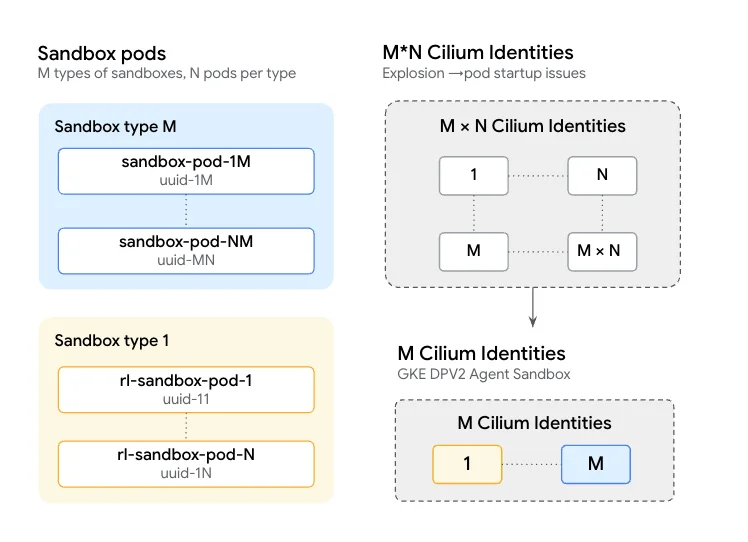
GKE Dataplane V2 uses eBPF to enforce network policies, mapping pod labels to numeric identities. Labels can therefore carry consequences beyond helping teams organize and inspect pods. Orchestrators often attach unique labels such as agent IDs, timestamps, or claim UIDs, and those values can make otherwise similar pods look distinct to the dataplane.
When each sandbox has a distinct label set, the dataplane may need to allocate a distinct identity and update its eBPF maps before the pod can start. Each step may be small in isolation; repeated at high churn, the work can add delay to pod creation. The tension is straightforward: operational systems often produce detailed metadata, while network policy systems need a manageable way to group workloads.
At larger scales, workloads can also approach the cluster wide ceiling of 65,536 network identities. That limit makes label design a capacity concern, not just a matter of tidy configuration. The challenge is to preserve security controls without letting incidental metadata drive identity counts. A unique sandbox name may help an operator track a particular execution, for example, but that doesn’t automatically make it useful as a network identity.
Keep high-cardinality metadata out of identity calculations
GKE’s approach has two parts. First, fields that aren’t used for service selector matching or resource grouping can be moved from pod labels to annotations. Dataplane V2 derives network identities from labels, so annotations can retain useful operational metadata without generating a distinct identity for each pod. This is a simple distinction with real architectural weight: teams can keep descriptive information available while choosing which fields shape network policy identity.
That choice needs to reflect how the cluster actually uses its metadata. If a field is needed for service selection or resource grouping, moving it out of labels could change how those systems find or organize pods. If it serves only as a changing identifier for observation or bookkeeping, an annotation may be a better fit. The point isn’t to strip away context; it’s to avoid making every piece of context part of the network identity calculation.
Second, Cilium label exclusion filters can tell the dataplane to ignore specific dynamic labels when calculating identities. For example, a cluster can exclude agents.x-k8s.io/sandbox-name-hash or timestamp through the cilium-config-emergency-override ConfigMap in kube-system. This can help when a framework adds high-cardinality labels that developers haven’t removed. It also offers a more targeted option where changing the framework’s labels isn’t practical.
With those labels excluded, pods for the same agent type can share a Cilium identity. That limits identity growth while retaining isolation and policy enforcement, helping sandboxes start quickly under heavy churn. The tradeoff is that identity grouping depends on the labels that remain in the calculation, so teams need to understand which distinctions their policies rely on. This is more significant than it looks: a metadata decision made upstream can affect both policy grouping and the pace at which new work becomes runnable.
Scaling beyond standard scheduling
Google positions Agent Sandbox as a way to create lightweight, secure execution environments on GKE. For workloads with very large numbers of concurrent sessions, Agent Substrate builds on the same networking approach and is designed to support higher density and fast state restoration. The distinction suggests two related scaling questions: how quickly a system can start isolated work, and how it can manage a much larger population of sessions over time.
In a benchmark with 200,000 agents, Agent Substrate sustained 500 activations per second, with suspend and resume latency below 500 milliseconds. It also bypasses Kubernetes scheduling limits, according to Google, and can run on existing GKE clusters. Those figures describe the reported benchmark, not a guarantee for every deployment; workload shape and configuration still matter. Here's the thing: the benchmark is useful because it puts activation and restoration in view alongside raw concurrency, but readers should keep those measures distinct.
What this means for teams building agent systems
The engineering takeaway is to treat labels as part of the network scaling design. Moving descriptive, high-cardinality fields into annotations and filtering unnecessary labels can prevent identity counts from growing with every sandbox. For teams, that means reviewing not only the labels they deliberately set, but also the ones added by frameworks and controllers. A label that looks harmless in a small deployment can behave differently when the same pattern repeats across a large, rapidly changing pool.
If you're working in this space, the practical question is which metadata needs to influence policy or grouping, and which fields only help identify an individual run. The answer will vary by workload, but making that distinction can keep network identities aligned with meaningful categories instead of transient details. And yet, these controls don’t remove the need to design and monitor the surrounding system: they address one source of identity growth and startup work.
For agent workloads where accelerator time is expensive, faster provisioning can translate into more useful compute time. Less identity churn can also give teams more room to scale without having each new sandbox consume a separate network identity. The benefit depends on the workload and its configuration. A configuration choice, then. Agent Sandbox and Agent Substrate are available on GKE for teams building isolated, high concurrency AI execution environments.