Google Agent Skills Add Automated Quality Gates and Evaluation Reports
The harder problem in an agent skill repository isn’t writing instructions. It’s keeping those instructions dependable as more teams contribute and more people rely on them. Google’s approach is to treat each skill change as a product change, with automated checks, evaluation evidence, and human review before release.
In my previous post about how Google Agent Skills are built, tested, and scaled, I covered the project’s origins, quality practices, and governance. This time, I’m looking at what’s been added since: automated quality gates, an AI agent that reviews skill design, and lessons other teams can apply in their own repositories.
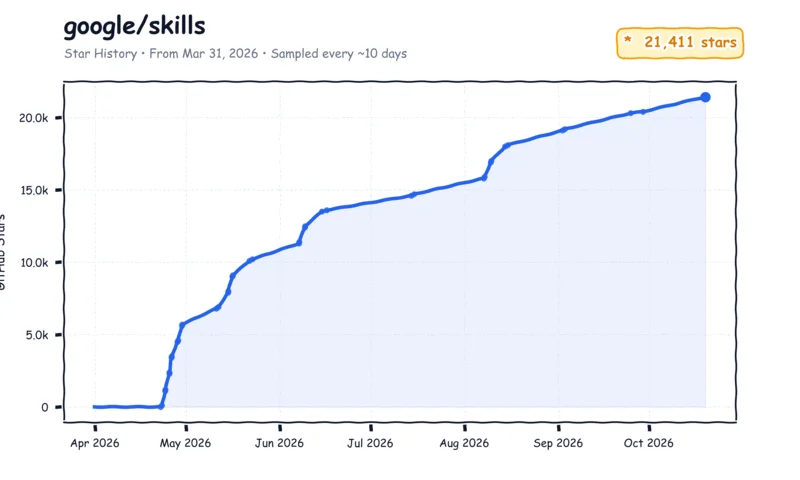
The project has grown since that earlier post. The Google Agent Skills repository has passed 21,000 GitHub stars, up from 15,000, and now contains more than 170 skills contributed by Google teams. Those skills are distributed across multiple AI platforms.
A developer can often write a SKILL.md, add a few instructions, and check the result by hand. That process breaks down when many people are changing skills at once. Small, unchecked edits can alter an agent’s behavior in ways that are hard to spot before users encounter them.
Treat each skill as a product release
A skill may look like documentation, but it does a different job. Documentation helps a person understand a subject; a skill influences an agent’s reasoning, tool choices, and actions. One poorly chosen instruction can lead an agent to use an invalid command flag, get stuck in a loop, or spend tokens on the wrong work.
That makes an edit to a skill a behavioral change. The practical response is to release skills with the kind of discipline used for software products. Google’s process rests on three requirements:
- Semantic versioning: Every change to a skill’s behavior requires an explicit version bump.
- Automated validation: Linters and validators check proposed changes before human or AI review.
- Evaluation evidence: Each change comes with a report comparing the updated skill with its previous version. For a new skill, the comparison is against an agent without that skill.
Gates before a skill reaches GitHub
The previous post listed linters, link checks, and AI-assisted checklists. The pipeline also includes two less visible checks: semantic versioning and evaluation-suite validation.
When someone submits a change to Google’s internal skills repository, a continuous integration and continuous delivery (CI/CD) pipeline starts. Before the skill can be exported to GitHub, it must clear six automated gates and receive human approval:
- Structural conformance: Checks directory layout, permitted files, and taxonomy.
- Skill linters: Check frontmatter, folder names, and Markdown formatting.
- Semantic versioning: Require a version bump for behavioral changes.
- Evaluation suite: Require a valid evaluation suite and a fresh report.
- Link validation: Check that links work.
- AI review agent: Examine skill quality and design standards.
- Human approval: A subject matter expert gives the final approval.
Structure and syntax checks
Every pull request is checked for structural and syntactical problems. The rules include matching a skill’s folder name to its metadata name; enforcing length limits for SKILL.md and its description; requiring all frontmatter metadata fields; and limiting each skill directory to an approved set of files and folders.
The checks also enforce Markdown formatting and keep the main README.md and machine-readable index.json registry up to date.
Versions with a purpose
Each skill declares a semantic version in the metadata at the top of its SKILL.md file. For example:
---
name: spanner-basics
metadata:
 version: "1.1.1"
 category: Databases
description: ...
---
The version must be a quoted string. YAML can interpret an unquoted value such as 2.0 as a number, which can break tools that expect a string.
The validator also checks how the version changes. New skills start at 1.0.0. Editing an existing skill’s instructions, scripts, or references requires a version bump; without one, the pull request is blocked. The usual reset rules apply: moving from 1.4.2 to a new major version means 2.0.0, while a minor bump becomes 1.5.0. In both cases, lower-order numbers reset to zero.
Why make this explicit if the agent just reads Markdown? The version is for developers and package tools, not something the model checks at runtime. Skills don’t update themselves in the background, so version checks add no network call or latency when an agent invokes one. Instead, a version lets developers compare an installed skill with the upstream catalog and choose when to update—for example, with npx skills update. Teams can also pin a critical skill to a known version, helping keep agent behavior reproducible across projects.
Evaluation suite checks
Continuous evaluations compare an agent’s performance with and without a skill. But the results only mean something if the tests are sound. A missing file reference or an expectation that bundles several criteria can make results noisy and hard to trust.
The validator parses both the evaluation suite and the pull request description, then checks that:
- File-based prompts resolve: If a prompt refers to a file, such as
@file:test_prompt.txt, that file must exist and contain something. - Expectations are atomic: Each one must test a single criterion. Compound expectations are blocked until they’re split apart; a later lesson in the post explains why.
- Tests don’t conflict or repeat: Duplicate prompts and conflicting expectations in the same suite are flagged.
- A report is included: Every pull request that changes a skill must link to an evaluation report in its description.
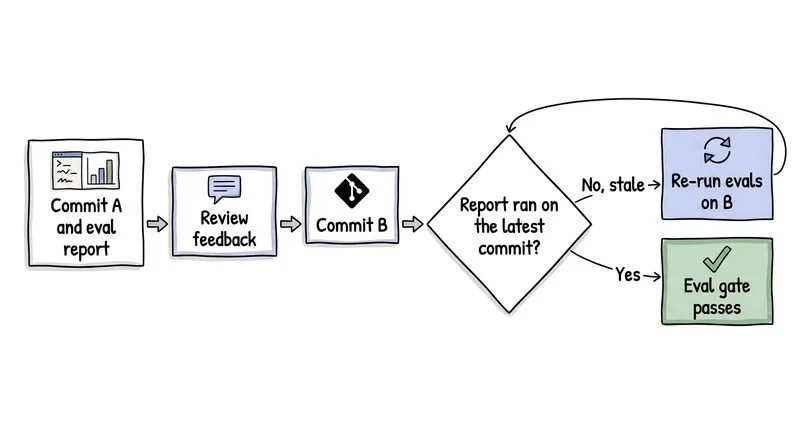
- The report is current: Because authors may update a pull request as reviewers comment, the linked evaluation must have run against its latest commit.
Checking links over time
More than 170 skills point to Google product documentation, and those pages can move after a skill has passed review. Google checks links in two ways: before a pull request is merged, its checks validate relative links, including files under references/; then, every Monday, a GitHub Actions workflow runs lychee against external links in the public repository and reports broken ones to skill owners.
Where an AI reviewer helps
Linters can catch malformed files and invalid fields, but they can’t tell whether an instruction is confusing, a reference guide is too long, or a task would work better as a Bash script than as a large language model (LLM) instruction.
Google added an AI review agent to its review pipeline. When a change touches a skill, the agent examines it using a dedicated review skill. Yes, a skill reviews other skills. The review rules are also intended to be useful to teams building their own skills.
1. Choose instructions for work that needs judgment
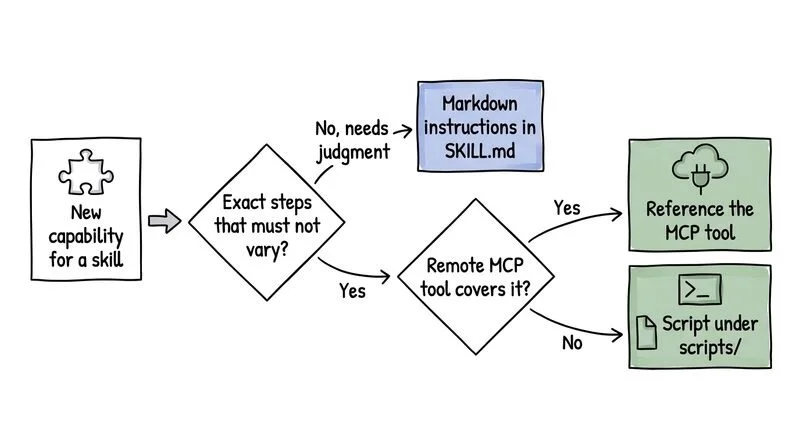
The reviewer’s first question is whether the task belongs in an instruction at all. A recurring mistake is the “deterministic trap”: putting a rigid sequence of command-line interface (CLI) commands directly into Markdown.
LLMs behave probabilistically. If a task depends on running commands in an exact order, asking a model to reproduce that sequence from prose creates opportunities for mistakes and hallucinations. Google’s reviewer draws a boundary between that kind of deterministic work and tasks that benefit from an agent’s judgment.
Fixed CLI sequences, JSON parsing, and deployment steps belong in executable files under scripts/. Instructions are better suited to work such as choosing an architecture, diagnosing error logs, or synthesizing code.
This also fits the Model Context Protocol (MCP) guidance from the previous post: use remote MCP tools when possible. If a CLI or API call is necessary, put it in a script rather than spelling out the command sequence in the instructions.
2. Organize information into L1, L2, and L3
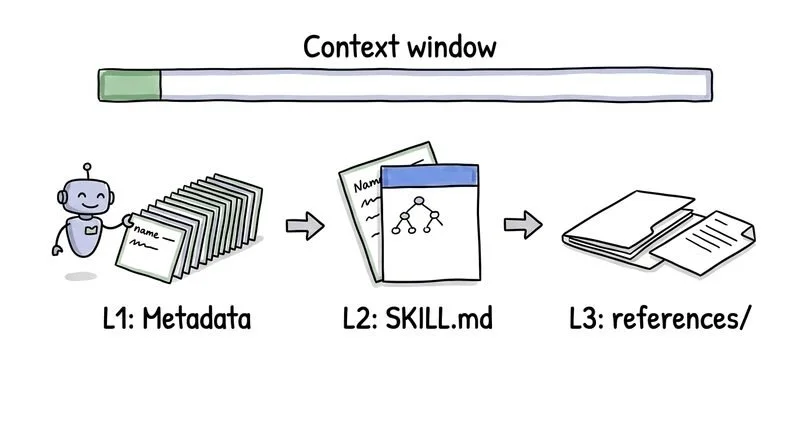
Context windows are limited. Loading a 2,000-line skill into an agent uses that context and can weaken its reasoning. Google’s AI reviewer therefore checks for a three-tier information hierarchy, following the progressive disclosure model used by Agent Skills.
Keep the rules close to the work
The structure of a skill affects whether an agent can find and use its instructions. The repository uses three layers: YAML frontmatter with a name and description for discovery and routing; a compact SKILL.md with workflows, decision trees, and guardrails, kept under 500 lines; and a references/ directory for detailed API material, schemas, and tables.
The AI reviewer enforces two rules for that reference directory. It must stay flat, with no subdirectories, and references must not chain: a link from SKILL.md to one file that then points to another is blocked. Flatness makes files easier to find; limiting references to one hop also reduces tool calls, latency, and cost. In evaluations, agents often stopped before following a second link.
Make scripts usable without a conversation
Helper scripts in scripts/ are expected to run directly in terminal sandboxes. That makes interactive prompts a design bug: an agent may have no way to answer them. Scripts should accept command-line flags or environment variables, explain their options through --help, and offer --dry-run or a confirmation flag before destructive actions. They should also keep machine-readable output, usually JSON, on standard output and send actionable errors to standard error.
The reviewer checks frontmatter against the Agent Skills Reference Specification, including the folded strip-chomping >- format for multiline descriptions. It also checks that descriptions follow the description guide and that long reference files include a table of contents with line hints.
### Front Matter & Discovery

- **Spec Compliance**: YAML front matter MUST strictly follow the Agent Skills
  Reference Specification (https://agentskills.io/specification). Use `>-`
  (folded strip-chomping) format for multi-line descriptions.
- **Description Quality**: The `description` field must follow the
  [Description Guide](references/description_guide.md).

### Content Structure & Authoring Quality

- **L1/L2/L3 Architecture**: Enforce modular structure. The main `SKILL.md`
  body must stay under 500 lines. Move deep domain reference material to
  `references/` (see [Skill Structure](references/skill_structure.md)).
- **Flat References Directory**: `references/` must be a flat directory (one
  level deep, no nested subdirectories). References > 100 lines must include a
  Table of Contents with line hints (see
  [Skill Structure](references/skill_structure.md)).
- **Avoid Deeply-Nested References**: Avoid deeply-nested references (e.g.,
  `SKILL.md` -> `references/guides.md` -> `assets/output.tmpl`). Keep
  reference structures shallow (one level of indirection from `SKILL.md`)
  because agents might not load such link targets fully.
Automation still has a boundary: once all automated checks pass, every pull request needs human approval. That reviewer is usually a subject matter expert; new skills also need approval from someone on the Central Skills team.
What repository history taught us
Six months of commits and pull request discussions exposed a few predictable ways a skills repository can make its own process harder.
1. Match CI rules to the files being changed
Early pull request checks used broad directory patterns. One rule demanded an approved bug-tracking ticket for every change, so even a one-line typo fix could be blocked. At the same time, new skills in deeper directories escaped inspection.
Scope checks to the operation and path that matter. A new skill and a small edit to an existing one may need different rules; verify the exact directory depth and whether files are being added or modified.
2. Give evaluations one thing to judge at a time
Compound expectations made evaluation scores inconsistent. Consider a requirement that an agent create a Cloud Storage bucket in us-central1, enable uniform bucket-level access, and apply lifecycle rules. If the agent missed just one part, an LLM judge could rate the whole expectation inconsistently.
# Bad: Compound expectation
- "The agent must create a Cloud Storage bucket in us-central1, enable
  uniform bucket-level access, and apply lifecycle rules."
Splitting that requirement into separate checks made results clearer and easier to debug:
# Good: Atomic expectations
- "The agent specifies us-central1 for the bucket location."
- "The agent enables uniform bucket-level access on the created bucket."
- "The agent defines a lifecycle configuration rule deleting objects
  older than 30 days."
Each expectation should test one criterion. That gives reviewers a clearer account of what passed and what failed.
3. Generate catalogs instead of asking contributors to maintain them
In a repository with many contributors, manually maintained documentation tables can drift within days. Generate indexes and catalogs with a script, then enforce their accuracy with a CI unit test. That lesson led to checks for README.md and index.json; the latter opens with the warning, “This file is generated. Do not edit it by hand.”
4. Run cheap checks before expensive AI reviews
Full evaluation suites and AI reviewer runs can quickly add token costs and CI time, especially when authors push frequent small commits. Here, structural conformance, skill linters, and semantic versioning run first as blocking checks. If one fails, the pipeline stops before launching the reviewer or evaluations.
That ordering is a practical cost control: deterministic checks catch basic failures early. Teams can add further limits, such as requiring a /run-evals pull request comment for expensive runs or rerunning automatically only when a diff exceeds a chosen threshold.
Build the engineering around the skill
Good prompts matter, but they can’t carry a growing skills repository on their own. Treat skills as products: version them, validate changes, and evaluate behavior. Put semantic versioning and atomic expectations behind automated CI gates; use an AI reviewer to catch design problems such as the deterministic trap; and check links before merging and on a schedule.
If you’re building a similar system, the history here points to a useful principle: make the rules easy for both people and agents to follow, then make the pipeline enforce them consistently.
Links and further reading
- Google Agent Skills repo: github.com/google/skills
- Previous post: Behind the scenes: How we build, test, and scale Google Agent Skills
- Launch announcement: Level Up Your Agents: Announcing Google's Official Skills Repository
- Skills tutorial: Introduction: What Are Google Cloud Agent Skills?
What’s next?
If this was useful, share it with your network and connect with me on LinkedIn, X, or Bluesky.
Thanks for reading!