Google Knowledge Catalog Connects Semantic Models for More Accurate AI Agents
AI agents can produce fluent answers while getting the business logic wrong. A revenue query might include cancelled orders or draw from an unvalidated staging table, even when the model can translate the question into SQL. Google’s Knowledge Catalog is designed to address that gap by giving agents access to the semantic definitions and data signals that teams already use to interpret their business.
The practical change is a shared context graph for models and metrics spread across data platforms. Knowledge Catalog now generally supports semantic models from Looker LookML, BigQuery Graph, dbt MetricFlow, Snowflake Semantic Views, Databricks Metric Views and SAP Core Schema Notation (CSN). It connects those definitions with schemas, lineage, data profiles, business glossary terms and other metadata, without requiring teams to move data or rewrite business logic in another language.
That approach targets a familiar failure mode in enterprise analytics: business rules exist, but they are scattered across tools. When an agent can’t find or interpret the definition of a metric, it may choose a plausible table and calculate a plausible number that doesn’t match the one finance or sales trusts. Knowledge Catalog aims to make those definitions discoverable across systems, while retaining information about where each one came from.
A shared graph for business definitions
Knowledge Catalog represents data assets and their connections as a graph. Tables, semantic models, glossary terms and data products form the nodes. Lineage, associations, schema keys, joins inferred from query history and join paths declared in semantic models form the edges. With these elements connected, an agent can move from a business concept to its formula, relevant data and permitted join path through the same context layer.
For companies with overlapping or conflicting definitions, provenance matters as much as discovery. Knowledge Catalog keeps definitions from different sources alongside one another instead of silently replacing one with another. Data stewards can see which system supplied each definition and investigate disagreements before an agent uses them to answer a business question.
The supported sources contribute different kinds of context:
Looker LookML indexes models, explores, views and dashboards through live sync from Looker Core. It captures compiled metric SQL, fan-out-safe join conditions, required filters and lineage from source tables to executive dashboards.
BigQuery Graph contributes native property-graph definitions, node and edge tables, graph measures and business synonyms. That gives agents a way to reason about connected entities using Graph Query Language traversals instead of relying on multi-table self-joins.
dbt MetricFlow links source objects to dbt models and metrics, with related quality test results, filters, saved queries, freshness service-level agreements and downstream exposures.
Snowflake Semantic Views via Horizon Catalog combines federated BigQuery or Google Cloud Lakehouse tables with Snowflake Horizon metadata. The imported context includes dimensions, facts, metric formulas, relationships and synonyms, as well as Data Metric Function quality scorecards and personally identifiable information masking tags.
Databricks Metric Views via Unity Catalog brings in metric view definitions, measure formulas, scoping filters and join cardinalities, alongside table certification badges and Lakehouse Monitoring profile results.
SAP Core Schema Notation via SAP Business Data Cloud captures business labels, dimensions and cube modeling patterns, default aggregations, currency and unit bindings, join associations and sensitivity flags when SAP BDC Data Products are federated through Google Cloud Lakehouse.
These sources can be navigated together. A LookML join, a dbt exposure, a Snowflake relationship and an SAP association each remain linked to the physical tables they depend on. That makes it possible to trace how a business definition connects to data across platforms, while giving stewards the source details needed to review competing definitions.

Side-by-side comparison of the same question in Gemini without Knowledge Catalog (left) and grounded in Knowledge Catalog (right). Highlights the grounded agent (right) giving an accurate response with less token and lower latency, compared to the agent without Knowledge Catalog (left) hallucinating and using more tokens with higher latency.
Context includes quality and operational knowledge
A correct metric formula can still return a misleading result if it runs against stale or uncertified data. Knowledge Catalog can associate semantic definitions with quality scores, freshness signals and lineage, giving an agent more information to judge the underlying assets before it generates SQL. That connection is important for teams that need to know not only what a metric means, but whether the data behind it is fit for use.
The catalog also combines structured definitions with context drawn from unstructured sources. Operational playbooks, meeting notes, chat threads and code can contain details that never made it into a formal metric definition. Google says Gemini-powered self-learning enrichment can identify missing or outdated context in these sources and turn it into governed, reusable context sets. The intent is to keep agent context current as business definitions change, with less dependence on manual curation alone.
According to Google’s internal benchmarks, grounding agents in Knowledge Catalog made them nearly four times more accurate, with up to 33% lower latency and up to 75% fewer tokens. Those figures are based on internal testing; the announcement doesn’t provide benchmark methodology or specify how results vary across workloads. They point to the potential operational value of giving an agent relevant definitions and metadata before it starts querying.
Knowledge Catalog can provide this context to Gemini agents, BigQuery Conversational Analytics and custom agents. The goal is for each to use the metrics, filters and join paths teams have already established, regardless of where those definitions live.
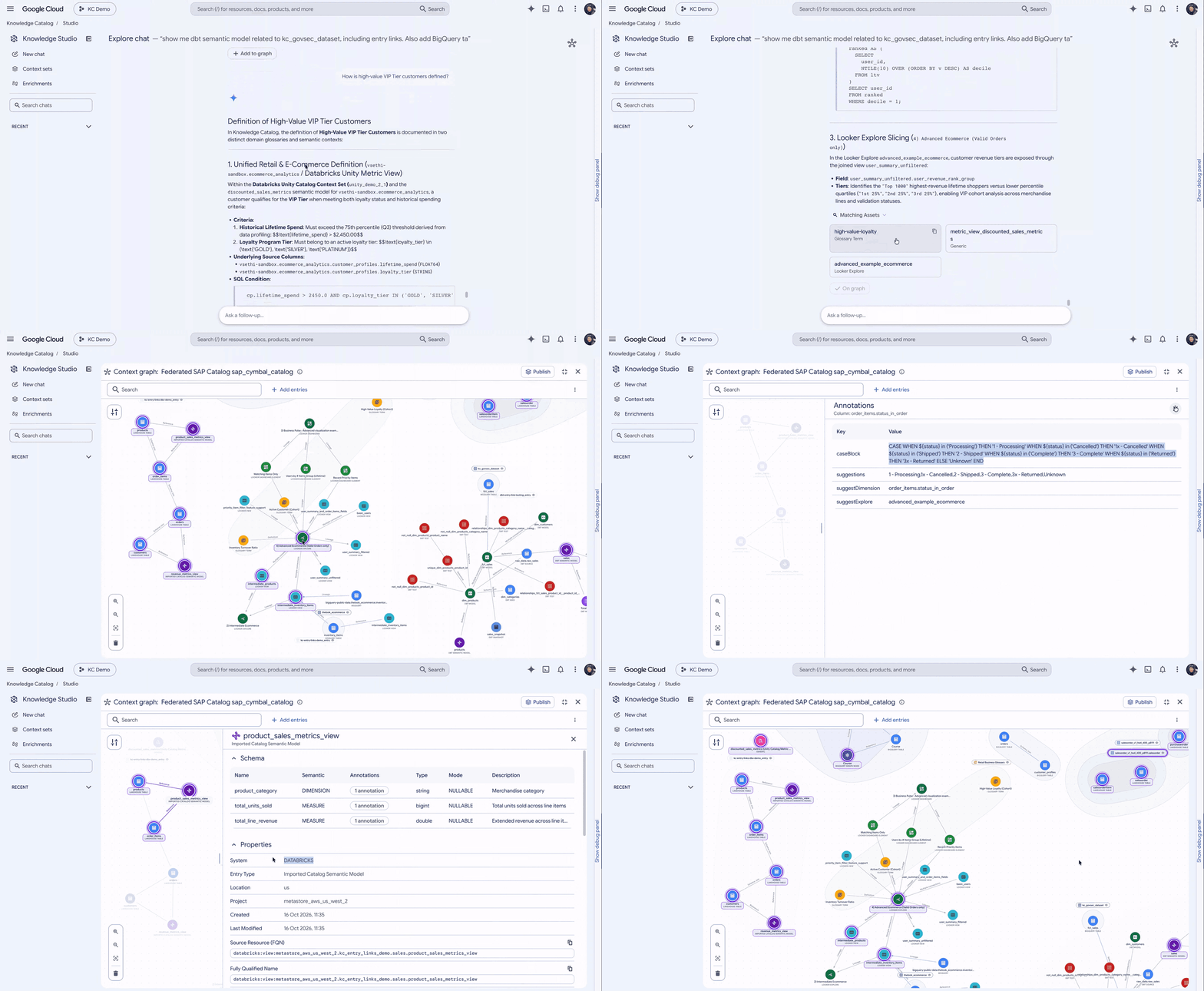
Navigating semantic models, join paths, and lineage on the context graph in Knowledge Studio.
Explore and package context for agents
Knowledge Studio, currently in preview, provides a workspace for exploring and managing the context graph. Users can inspect semantic definitions through natural-language prompts and follow connections on a graph canvas. Once teams have checked the assets and definitions they want agents to use, they can package them into context sets organized around particular domains or use cases. Gemini and custom agents can then consume those sets in production.
For the original revenue question, the intended workflow is straightforward: the agent discovers the trusted metric, applies the formula and filters defined by domain experts, follows the appropriate join keys across systems and checks signals about the underlying data. The answer should then align with the business’s established reporting logic rather than the agent’s best guess.
Teams can start by exploring their graph in Knowledge Studio and reviewing the Knowledge Catalog documentation for source connections. The larger test will be whether shared definitions and quality signals can make agents’ answers dependable across the data estate as those definitions evolve.