ASUS Arc Pro B70 Brings 32GB of VRAM to European AI Workstations for €1,799
For developers who need 32GB of graphics memory for local AI workloads, ASUS has brought a new option to Germany, Austria and Switzerland. The catch is the price: its UGen Intel Arc Pro B70 is listed at €1,799 in Germany and Austria, and CHF 1,799 in Switzerland. That puts the card in premium territory, where buyers will expect clear gains in performance, software support and workstation capability.
Those prices make the UGen a purchase that needs a specific justification. A large memory pool can matter when a model or dataset won’t fit on a smaller card, but capacity alone doesn’t say how quickly the GPU will complete a job. Buyers will also need to consider how the card behaves in their software, and whether its performance holds up during long workloads. For teams building local AI systems, those details can matter as much as the headline specification.
ASUS’s version of Intel’s workstation GPU
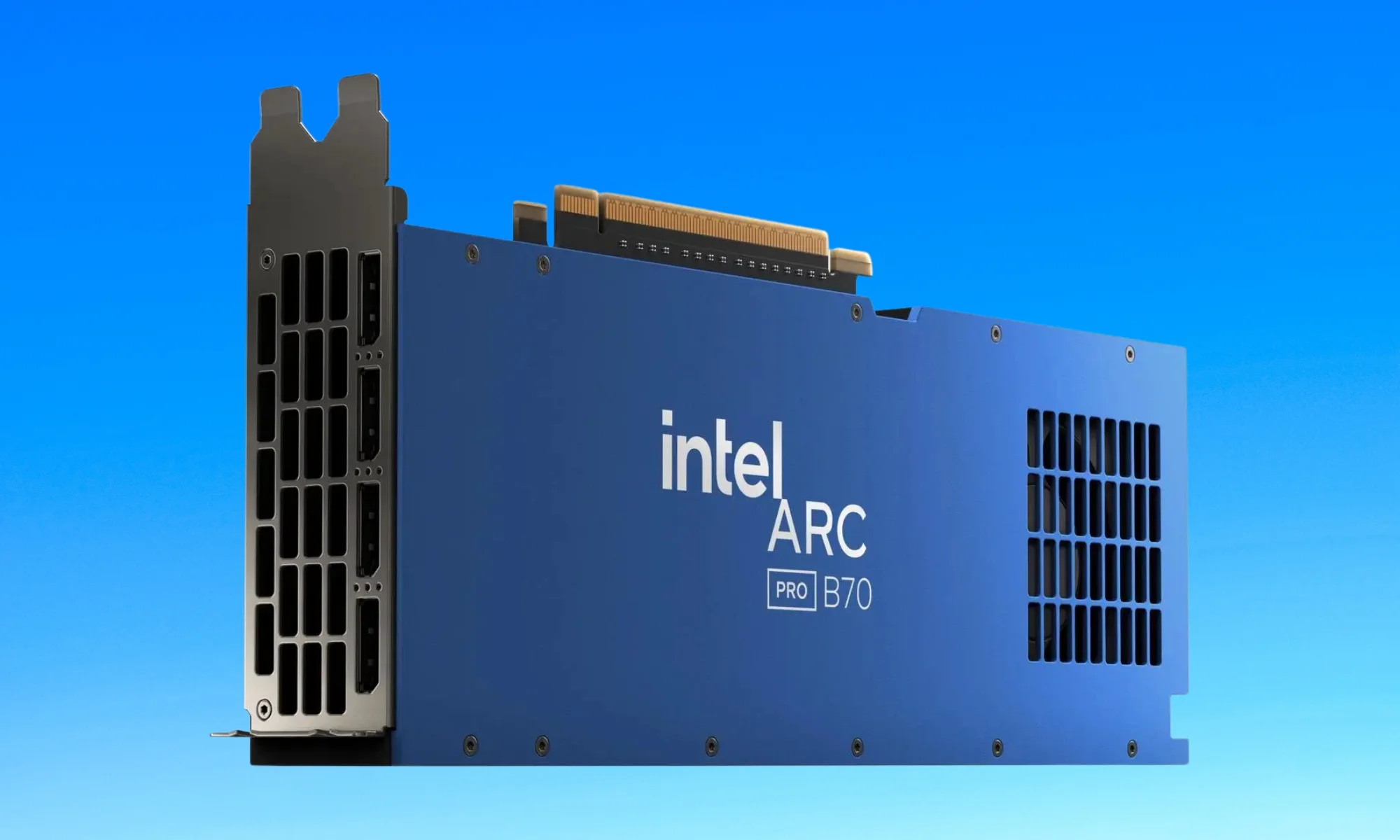
The UGen is ASUS’s version of Intel’s Arc Pro B70, a workstation GPU first announced in March 2026. Intel set a $949 starting price for its own model; the figures aren’t directly comparable because they cover different products and markets, and ASUS’s European price includes VAT. Still, the gap gives buyers a reason to look closely at what ASUS’s design adds.
Some of that difference may reflect the particular board, its cooling design, regional costs and the way each product is sold. The available details don’t establish how much each factor contributes, though, or whether ASUS’s version delivers a performance advantage. A higher price can be justified by a better fit for a workstation, but the listing alone doesn’t demonstrate that fit. Buyers will need product tests and compatibility information before they can judge the premium.
Memory capacity is the central appeal
Built on Intel’s Xe2 architecture, the card pairs 32 Xe2 cores and 256 XMX engines with 32GB of ECC GDDR6 memory. That capacity is intended for professional applications and local AI inference, where running models on a workstation can reduce dependence on cloud services and give organizations more control over sensitive data.
For inference, memory capacity can determine whether a model runs on a single GPU at all. If it fits, a local setup may let a team keep data and workloads on its own machines; if it doesn’t, the team may have to change the model, split the workload or look to a different system. More memory can therefore remove one practical constraint. It won’t, by itself, establish how fast the model runs or how easily developers can deploy it.
The ECC memory is another workstation-oriented feature: error correction can help address certain memory errors during operation. That’s relevant in systems expected to run demanding jobs for long periods, though the source details don’t quantify its effect on reliability or performance. For developers, the useful question is how these specifications translate into behavior in the frameworks and applications they already use.
ASUS uses a dual-slot blower cooler and rates the card at 310W, compared with 230W for Intel’s reference model. The higher power draw makes cooling and power delivery relevant parts of any workstation plan, particularly for sustained workloads. A blower can direct much of its exhaust out of the case, which can help in some multi-card layouts, but the card’s rated draw still has to be accommodated by the system.
ASUS also promotes multi-GPU systems. Four UGen cards could provide 128GB of video memory, though the GPUs alone would total €7,196 at the announced European price. That configuration may suit workloads where memory capacity is a constraint, but the cost makes the case for measurable performance gains especially important.
Memory totals don’t automatically combine into one larger pool for every workload. Multi-GPU software needs to distribute work and data across the cards, and the results depend on how the model and tools handle that arrangement. Four cards could offer a substantial amount of installed memory, but developers should confirm that their workload can use it effectively before treating the total as a practical capacity figure. A four-card build also makes the 310W rating and cooling plan more consequential.
A premium price needs proof
At roughly $2,000 by simple currency conversion, ASUS’s European listing lands near the US launch price of NVIDIA’s GeForce RTX 5090, which debuted at $1,999 with 32GB of GDDR7. The cards target different workloads, so the price comparison doesn’t settle which one offers better value. It does show how high the bar is for ASUS: professionals will want evidence that the B70’s memory, workstation features and software support fit their needs.
The comparison is useful as a price signal, not as a performance verdict. Different GPU families can have different strengths across AI inference, professional applications and software ecosystems, and the listed memory types don’t settle those questions. A buyer choosing between them needs results from the applications they plan to run, alongside information about driver support and system requirements. This is more significant than it looks: for a workstation card, the cost of a poor software fit can outweigh the appeal of a larger specification sheet.
Availability and the questions buyers still face
US pricing remains uncertain. ASUS hasn’t announced a US price or availability date for the UGen model. Intel’s own Arc Pro B70 launched with a $949 starting price, though Newegg currently lists one Intel model at $1,945.99; prices can vary by listing and seller.
That spread makes it difficult to use a single listing as a guide to what buyers will pay. It also leaves an open question for developers outside the announced European markets: whether ASUS will offer this model elsewhere, and at what price. For now, anyone weighing the UGen has to compare the confirmed regional listing with the systems and software they can actually buy and support.
What the premium has to deliver
My read is that the B70’s 32GB capacity gives it a clear point of interest for developers whose models exceed the memory limits of mainstream cards. Whether ASUS’s version earns its premium will depend on real-world AI performance, software compatibility and how well it sustains demanding workloads.
If you're working in this space, the useful evidence will be workload-specific: whether your models fit, how quickly inference runs, and whether your software stack supports the card without workarounds. The announced specifications make the UGen an option worth examining for memory-bound tasks. They don’t yet show that ASUS’s price buys a better workstation experience. And yet, for teams that need this capacity locally, the card could address a concrete limitation—provided the software and measured performance hold up.
Not a spec-sheet decision.